Writing and Circulating a “Free Palestine”: Notes on an Overlooked Magazine
Rami Rmeileh & Sorcha Thomson
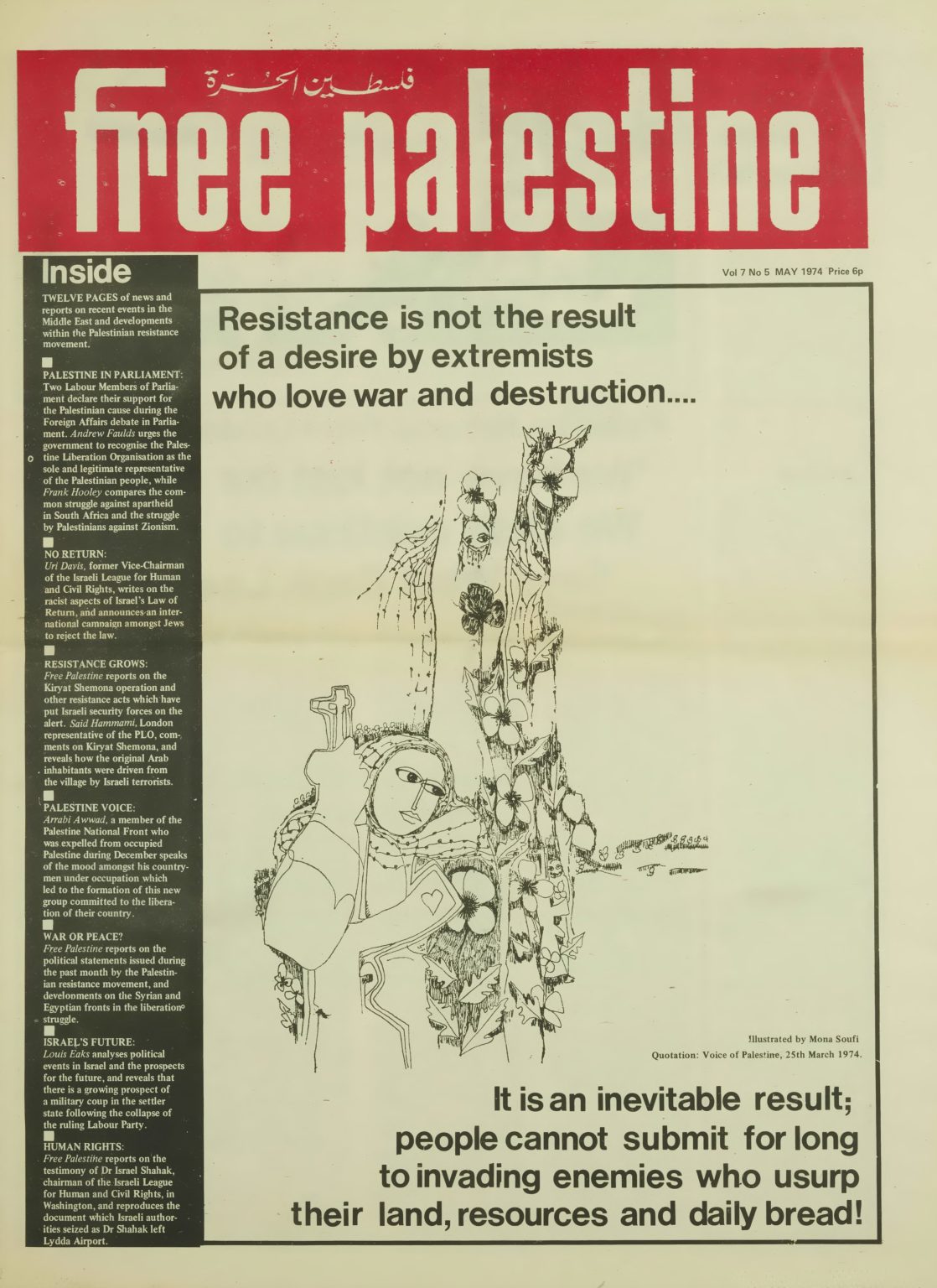
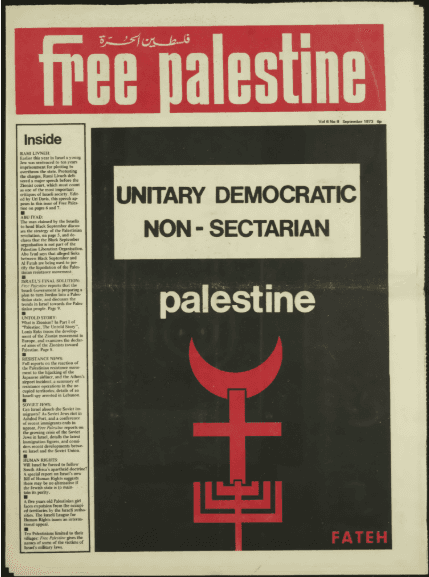
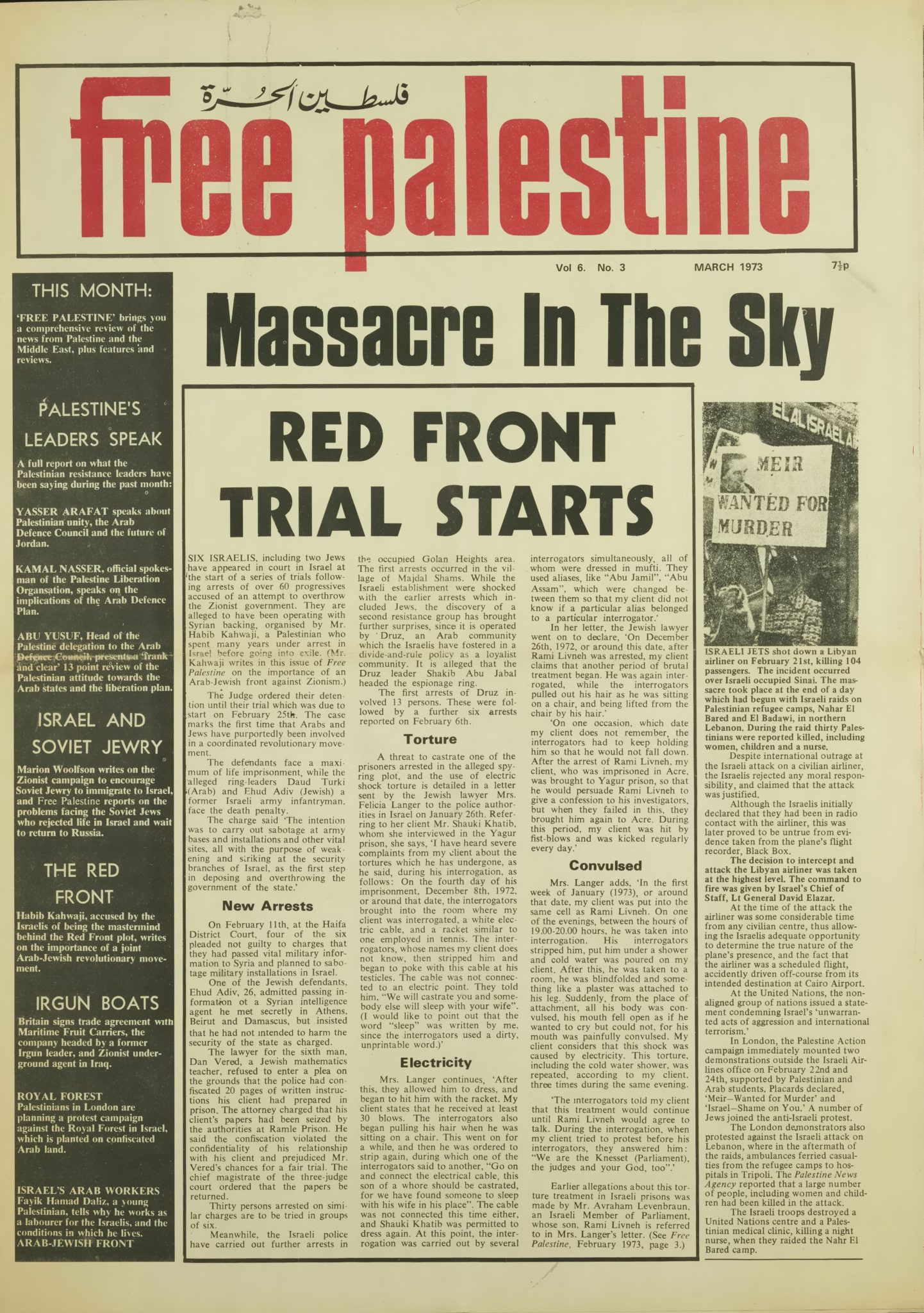
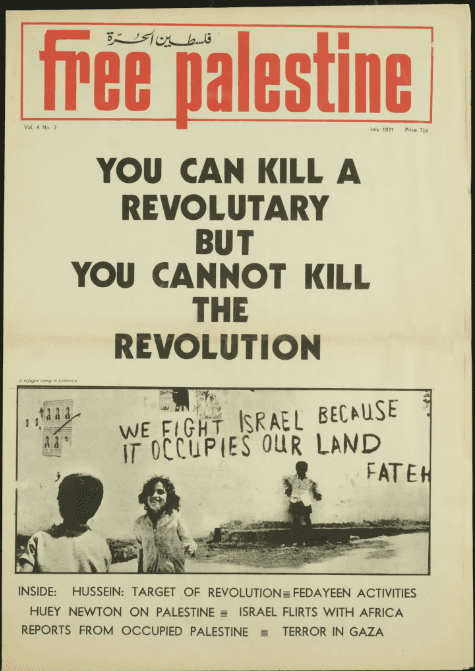
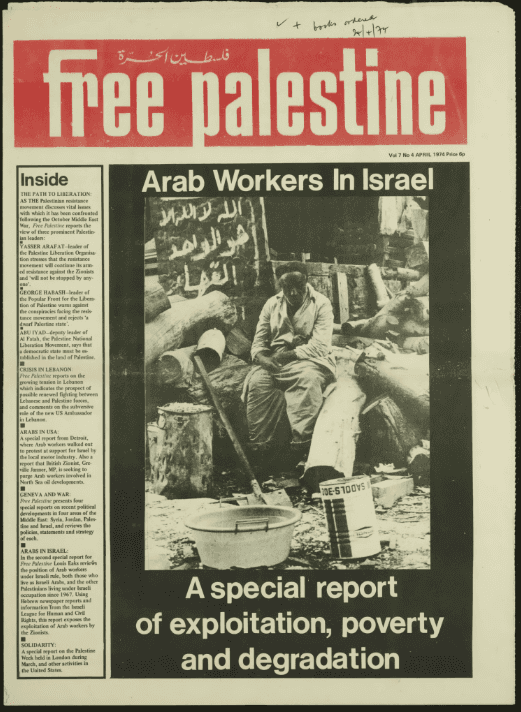
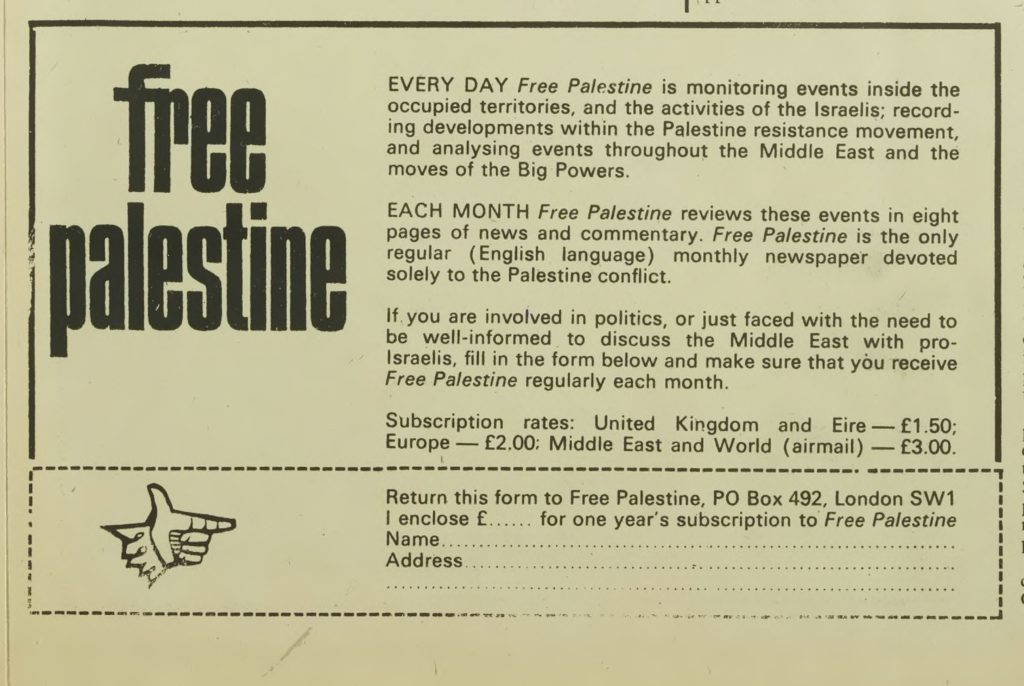
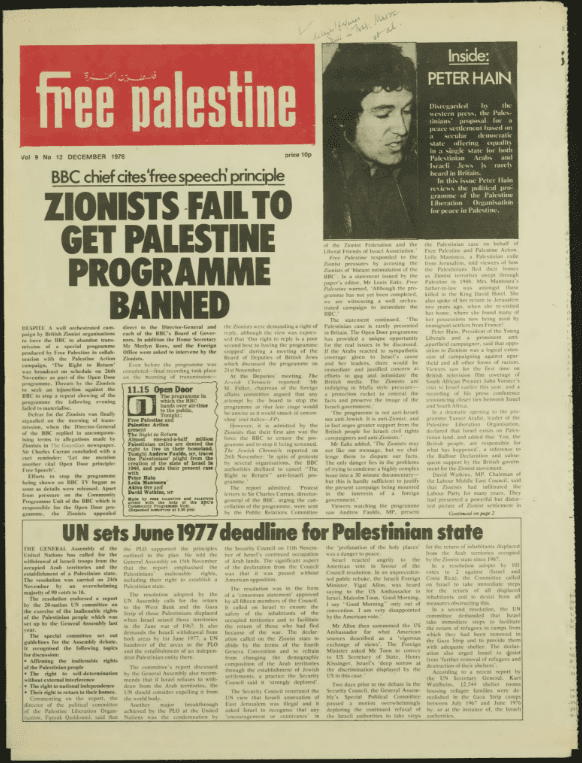
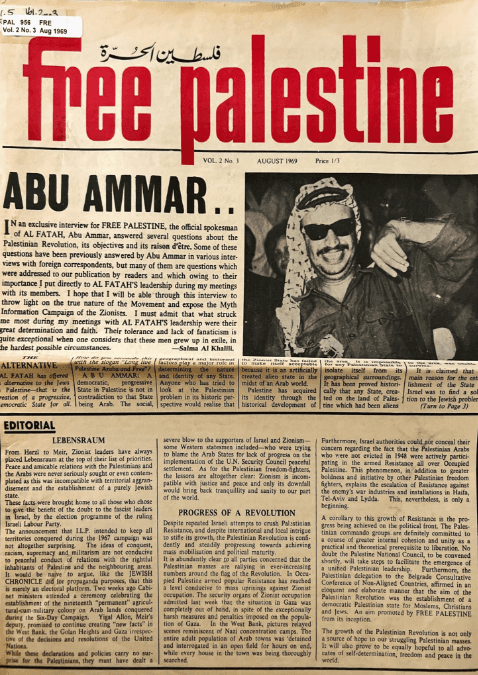
In June 1968, Dr. Abdulwahab Kayyali, a PhD student at University College London, founded the Free Palestine magazine alongside other Palestinians and allies residing in Britain. From a small office in central London, the group produced the publication in its entirety, from writing and editing to printing and distribution. Published monthly in Britain until the late 1980s, Free Palestine now constitutes a largely overlooked archive of the Palestine solidarity movement during a formative period of global political realignment and struggle. Despite precarious funding conditions, and having to operate within a hostile Zionist climate, the magazine circulated widely, from its offices in London to reach student groups, solidarity committees, parliamentary offices, embassies, conferences, refugee camps, and prisons across the world.
It was published mainly during the years of the Palestinian Revolution, when the horizon of liberation was expanding in sight and resonance across the world. This period followed the Arab defeat in the June 1967 War, after which Palestinian resistance organizations assumed control of the Palestine Liberation Organization (PLO) and reoriented it as a national umbrella committed to liberation through armed struggle. These organizations were inspired by and built networks with fraternal anticolonial and socialist struggles in Algeria, Vietnam, Cuba, China, and elsewhere. Alongside Palestinian unions of women, students, workers, artists, and more, they engaged in a widespread solidarity-building campaign to center Palestinian liberation by communicating its aims, strategies, histories, and visions to the rest of the world.
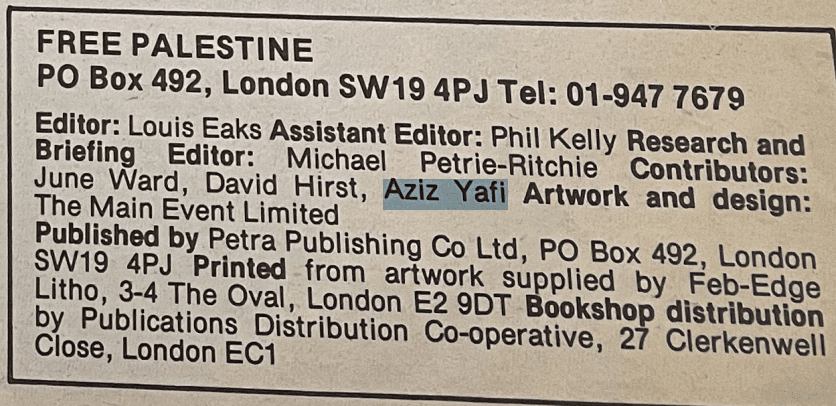
Figure 1. screenshot form the magazine detailing the team and office.
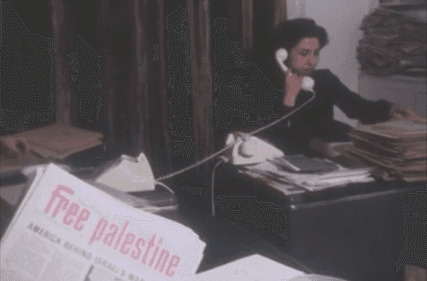
Figure 2. Free Palestine being printed and distributed from an office in Pimlico, London. Still from footage found on British Pathe (undated and now removed).
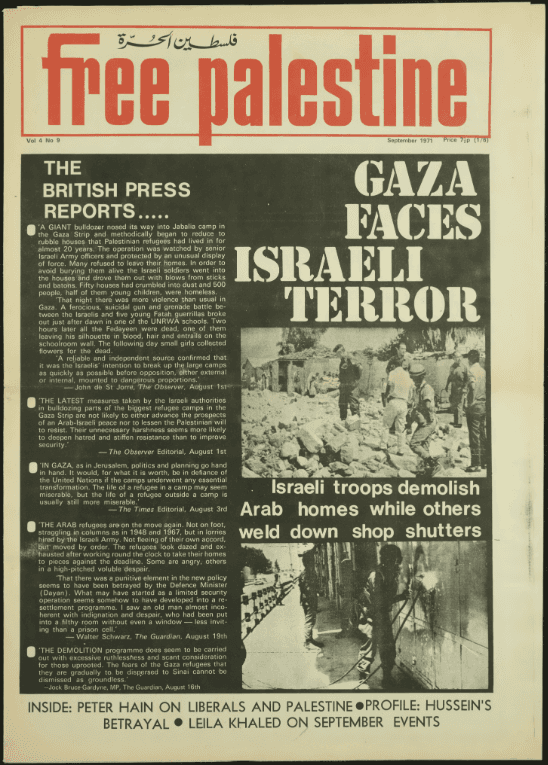
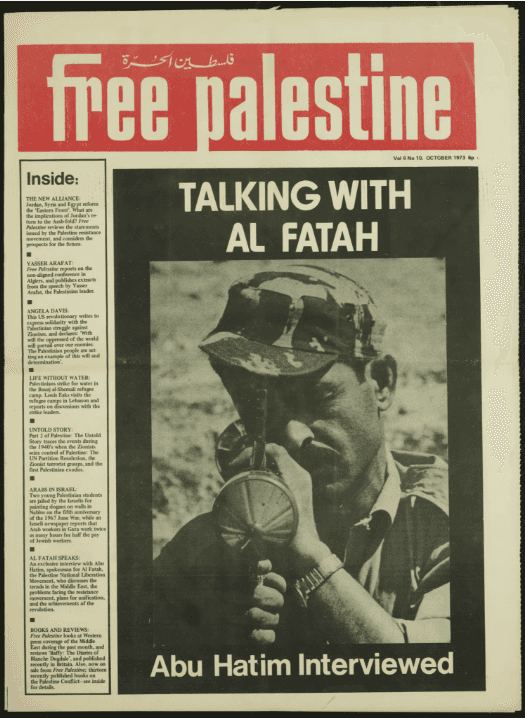
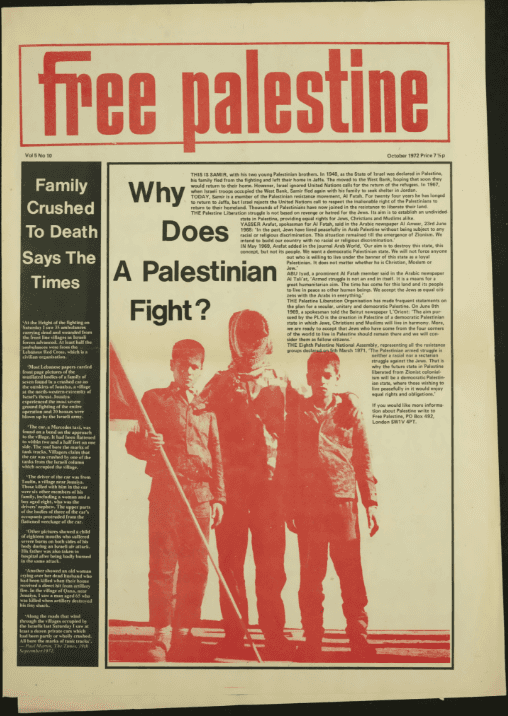
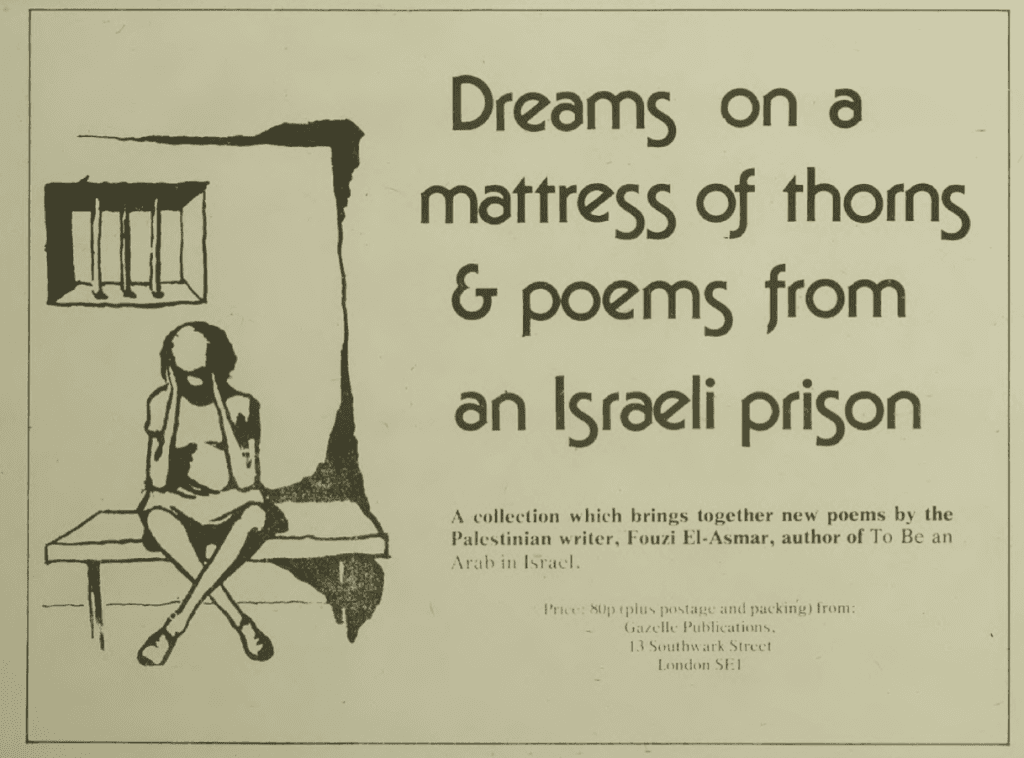
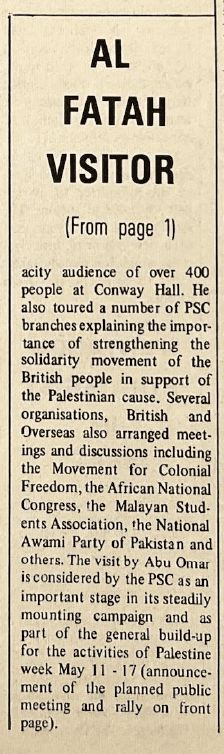
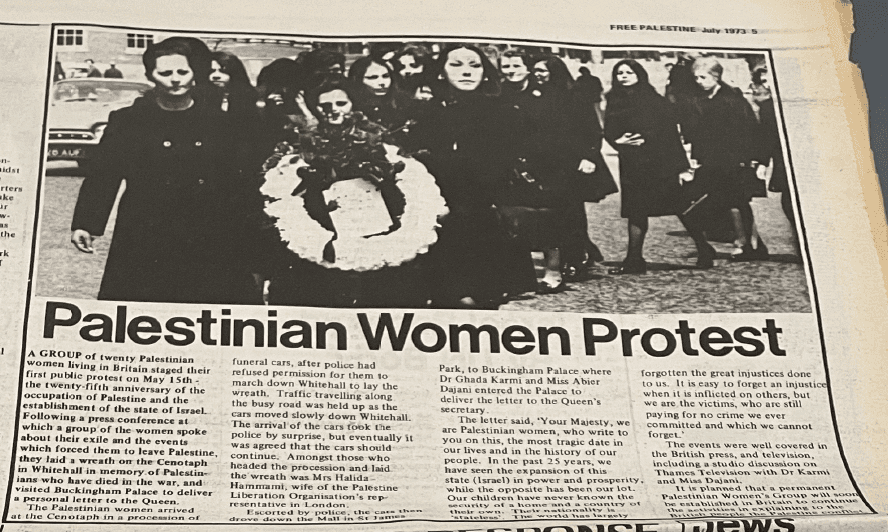
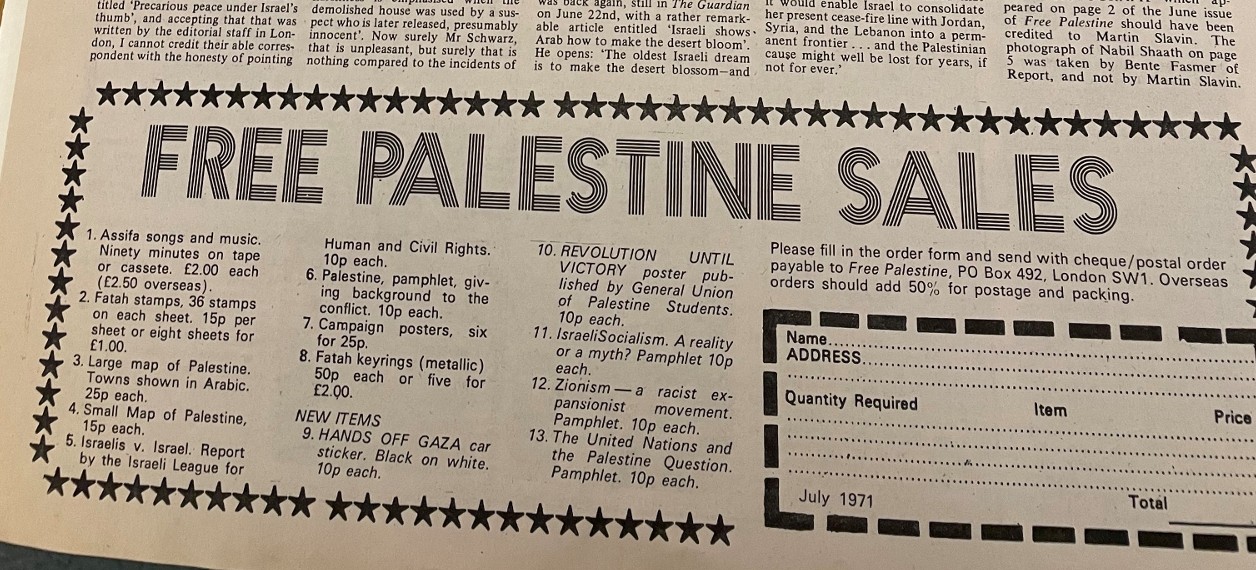
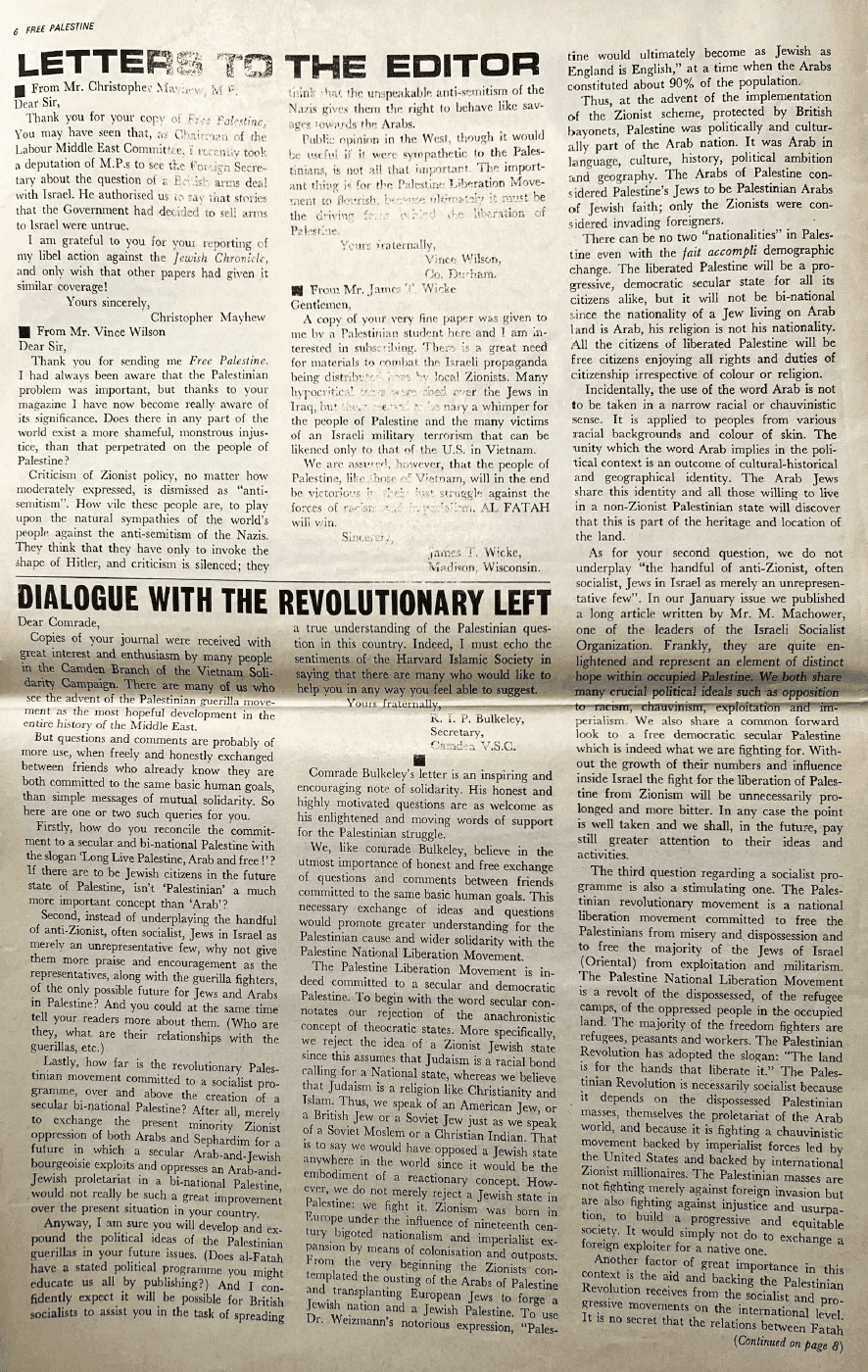
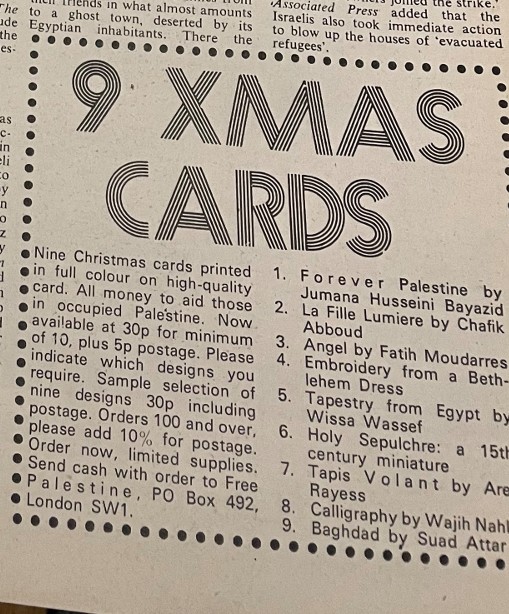
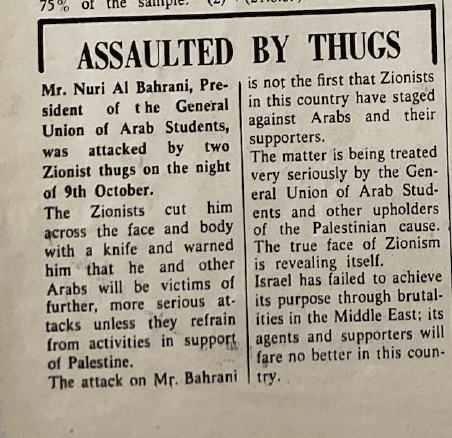
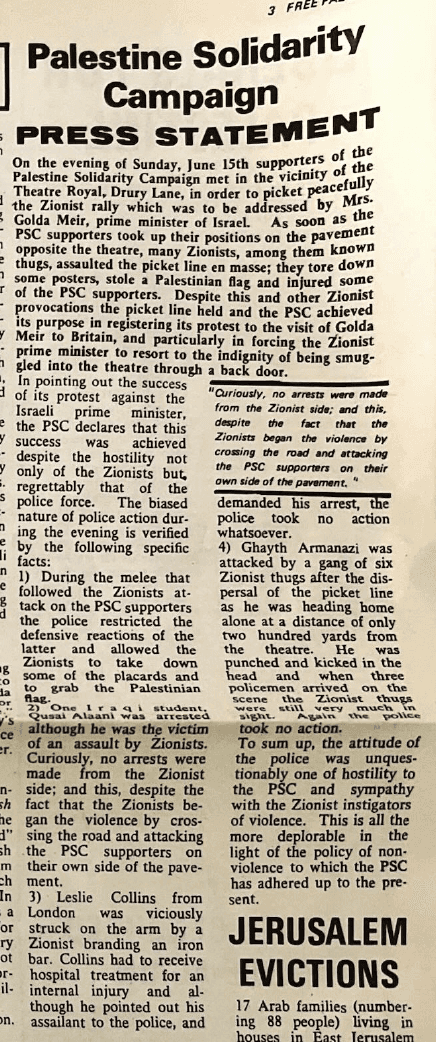
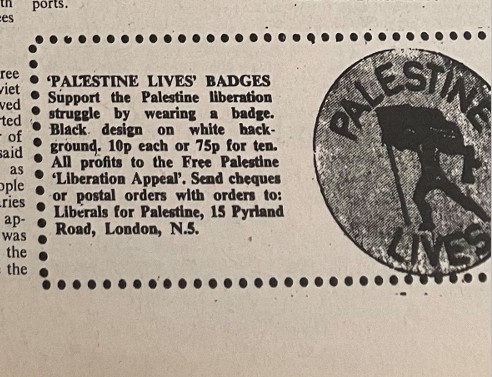
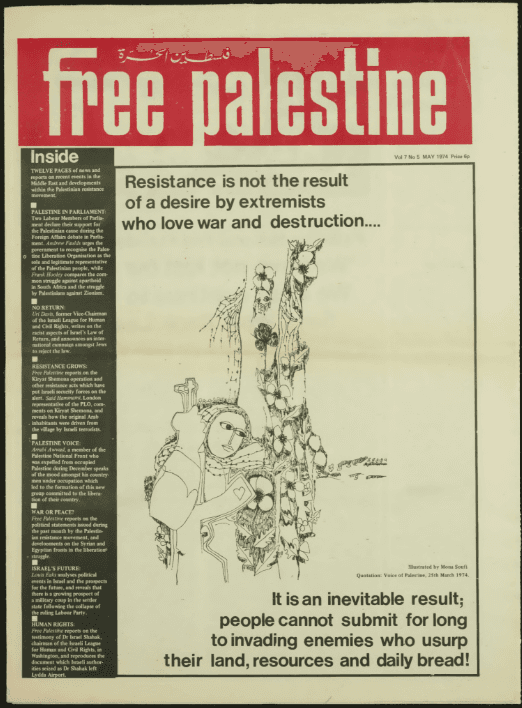
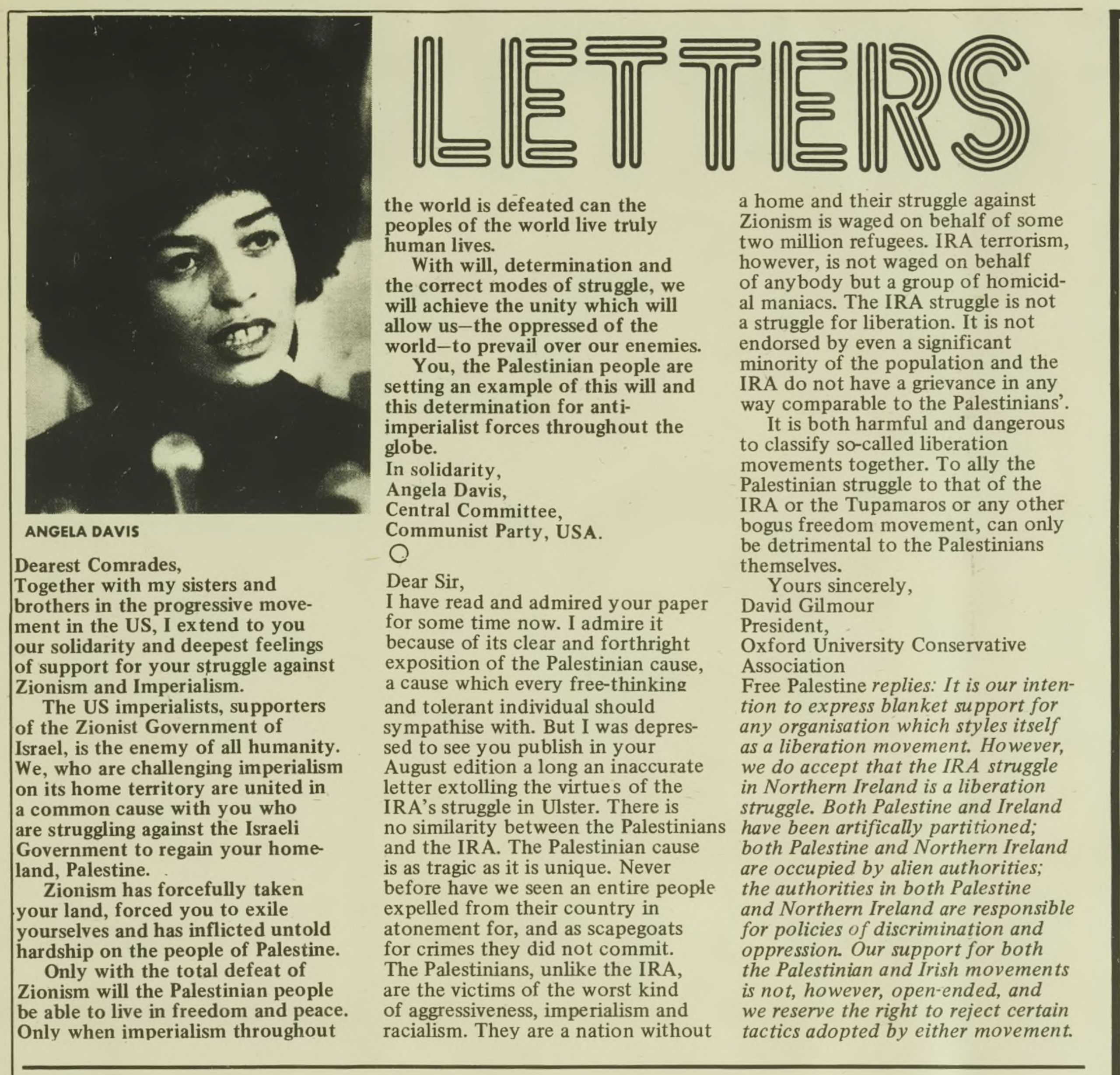
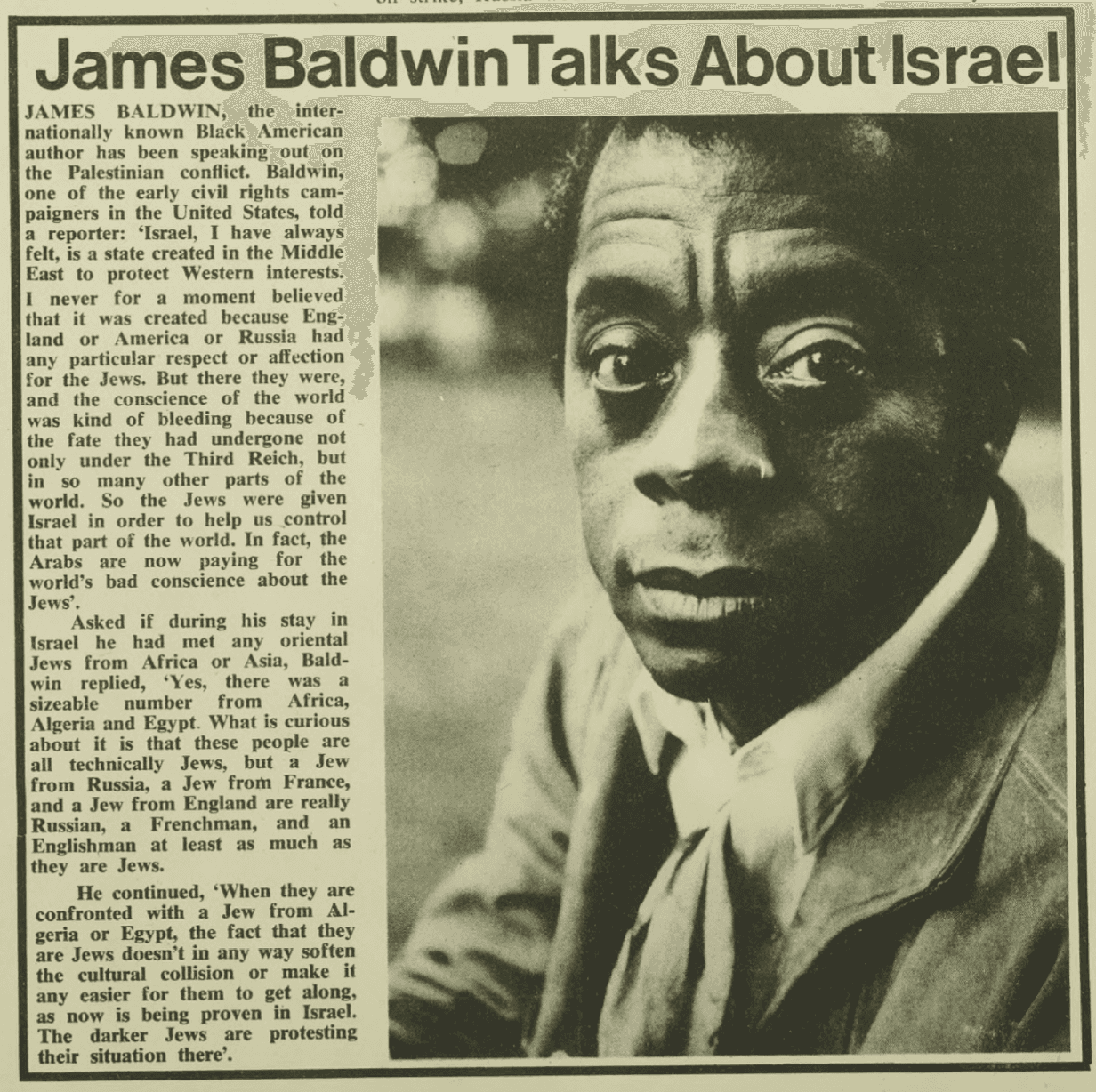
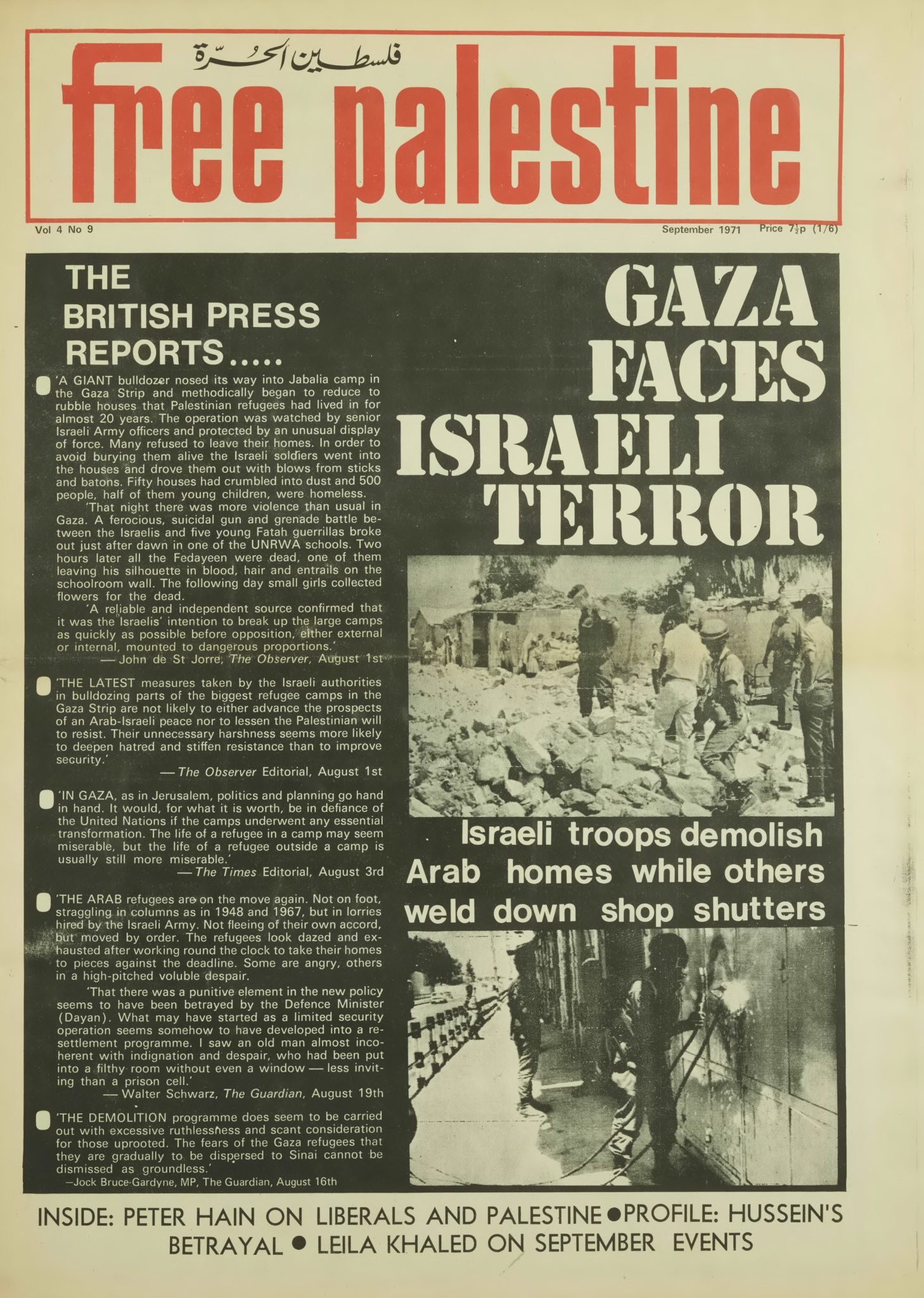
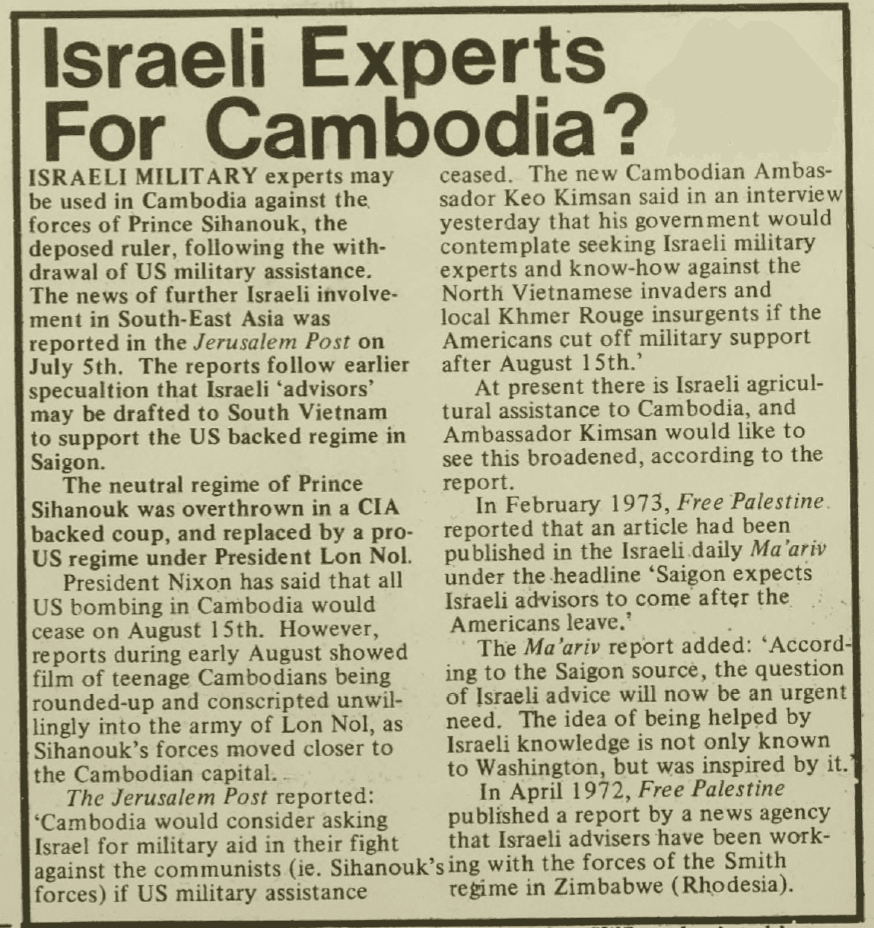
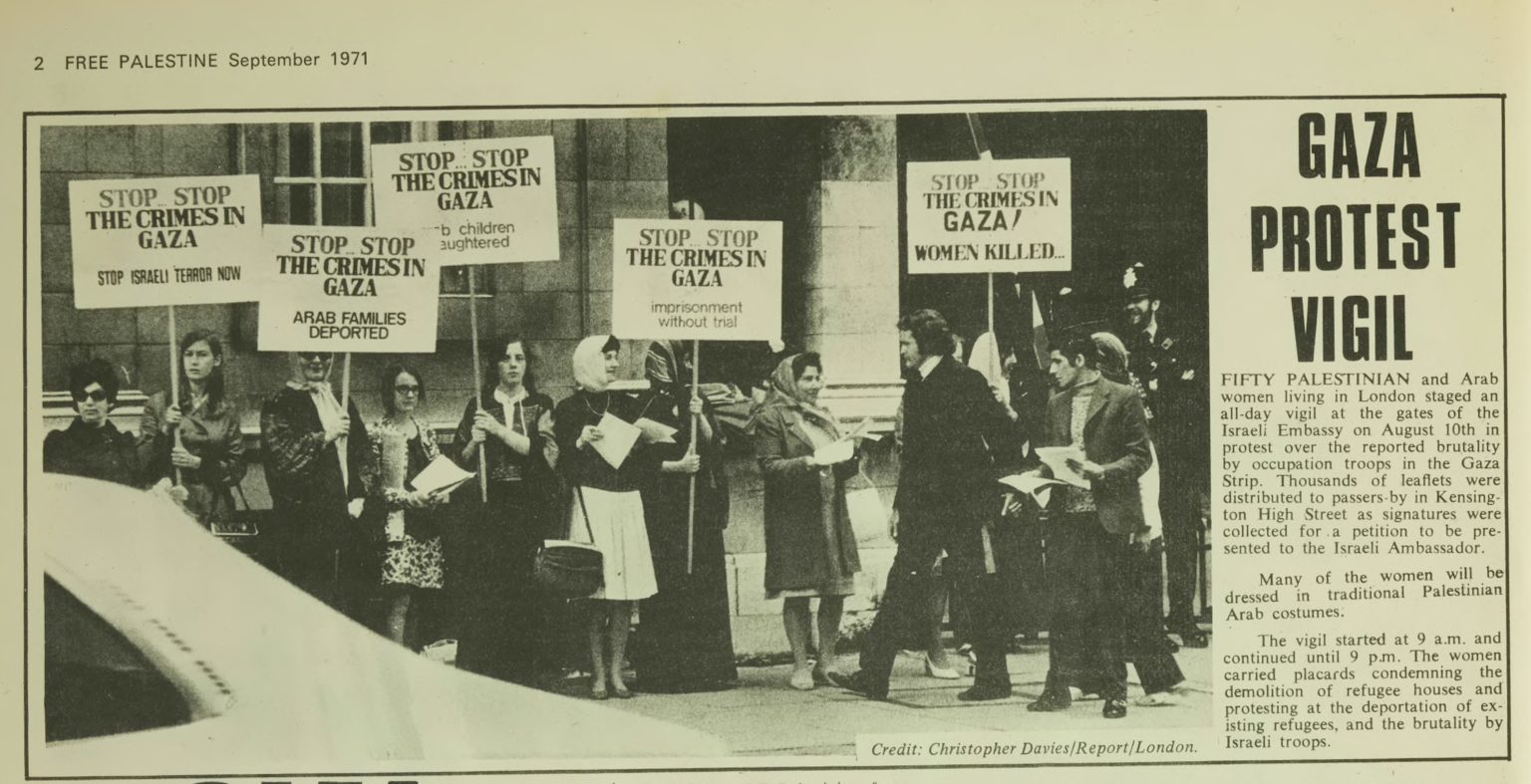
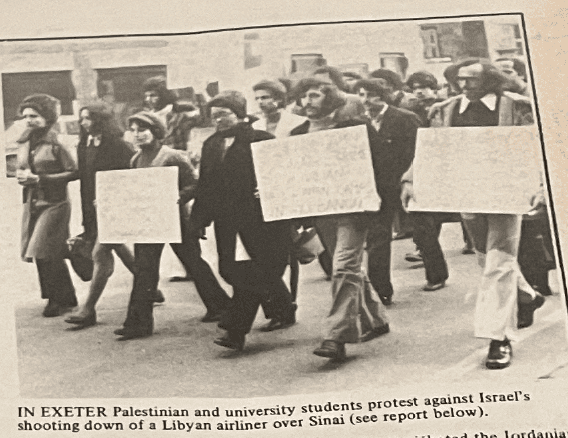
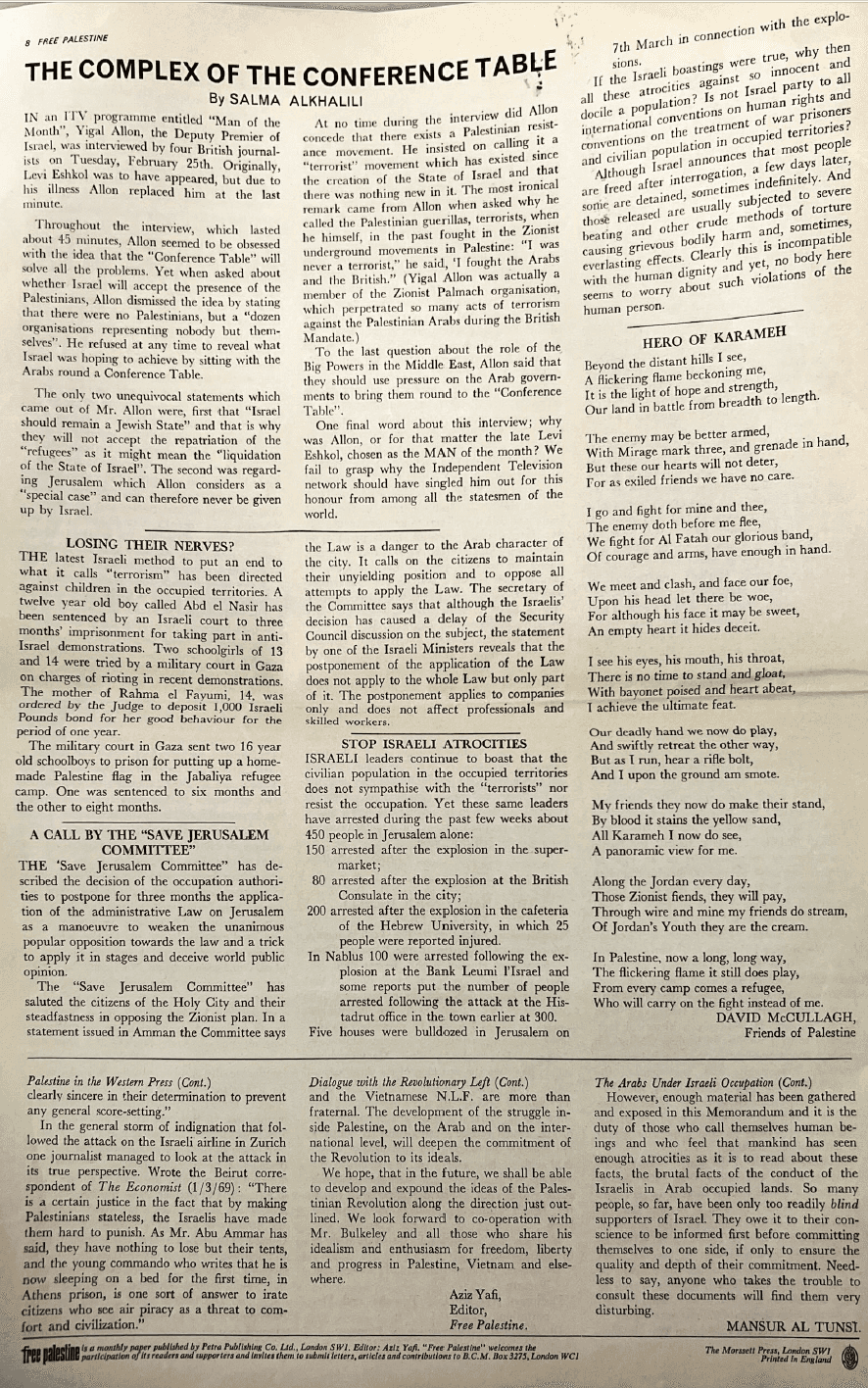
Free Palestine functioned simultaneously as a means of communication and as a record of solidarity in practice. Its pages included reports on the conditions in Palestine and in exile, accounts of Israeli colonial violence, the activities of the Palestinian liberation movement, exclusive interviews with Palestinian leaders and political figures, and letters and correspondence from readers. It offered analysis of Western media representations of Palestinians and Palestine, published educational materials, documented conferences, delegations, and summer camps, and covered connections with other internationalist struggles for liberation. In addition to spreading information and mobilizing support through the paper, the team behind the publication participated in speaking tours, demonstrations, and lobbying alongside other organizations and individuals committed to the principles of Palestinian liberation.
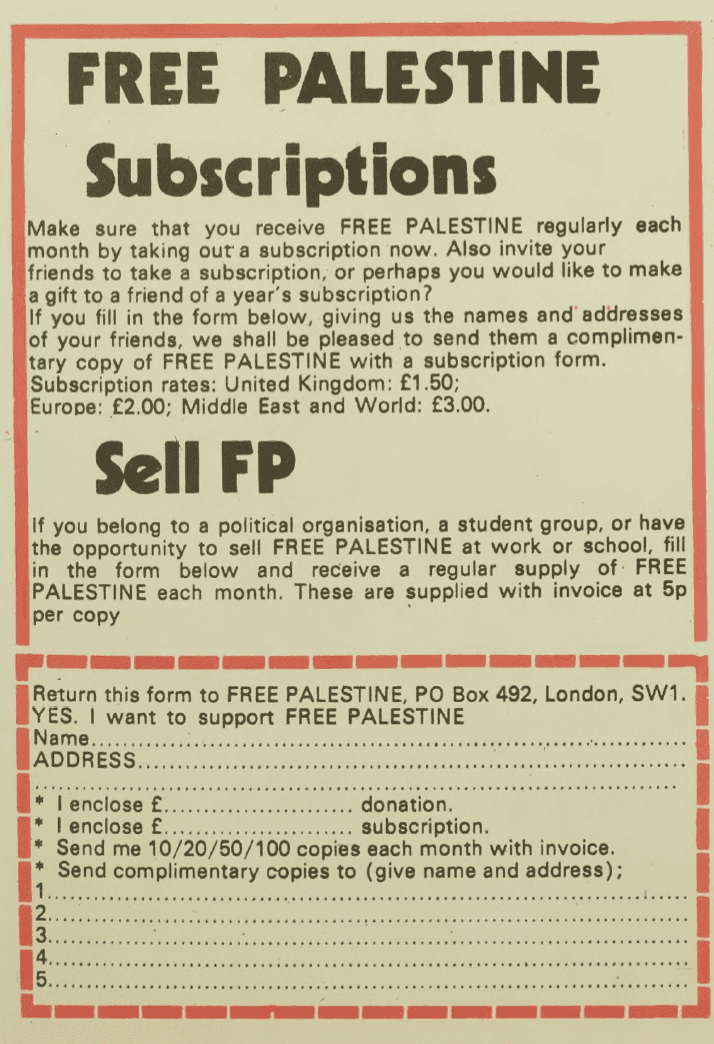
The day-to-day workings of Free Palestine can be glimpsed through their scattered archival records, which consist primarily of correspondence between editors and with their readers, associated organizations, and supporters. This correspondence details the back and forth between people that constituted the making of the magazine. Readers and supporters were regularly invited to send letters to a P.O. Box in southwest London, suggesting a sustained dialogue between the publication and its audience. Different editors took the lead at various points in the magazine’s lifetime, each bringing to some extent their own editorial style and political networks to the pages of the publication.
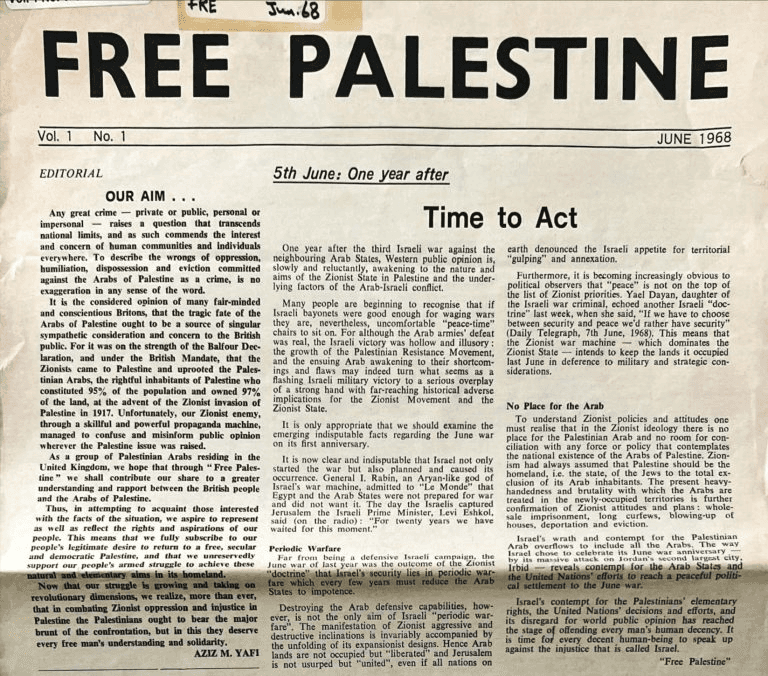
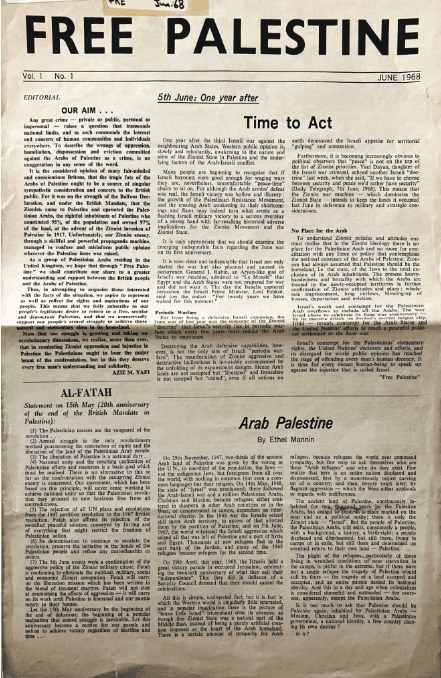
Figure 3. First Issue of Free Palestine issues in June, 1968 with an editorial written by Aziz M. Yaffi detailing the magazine’s aims.
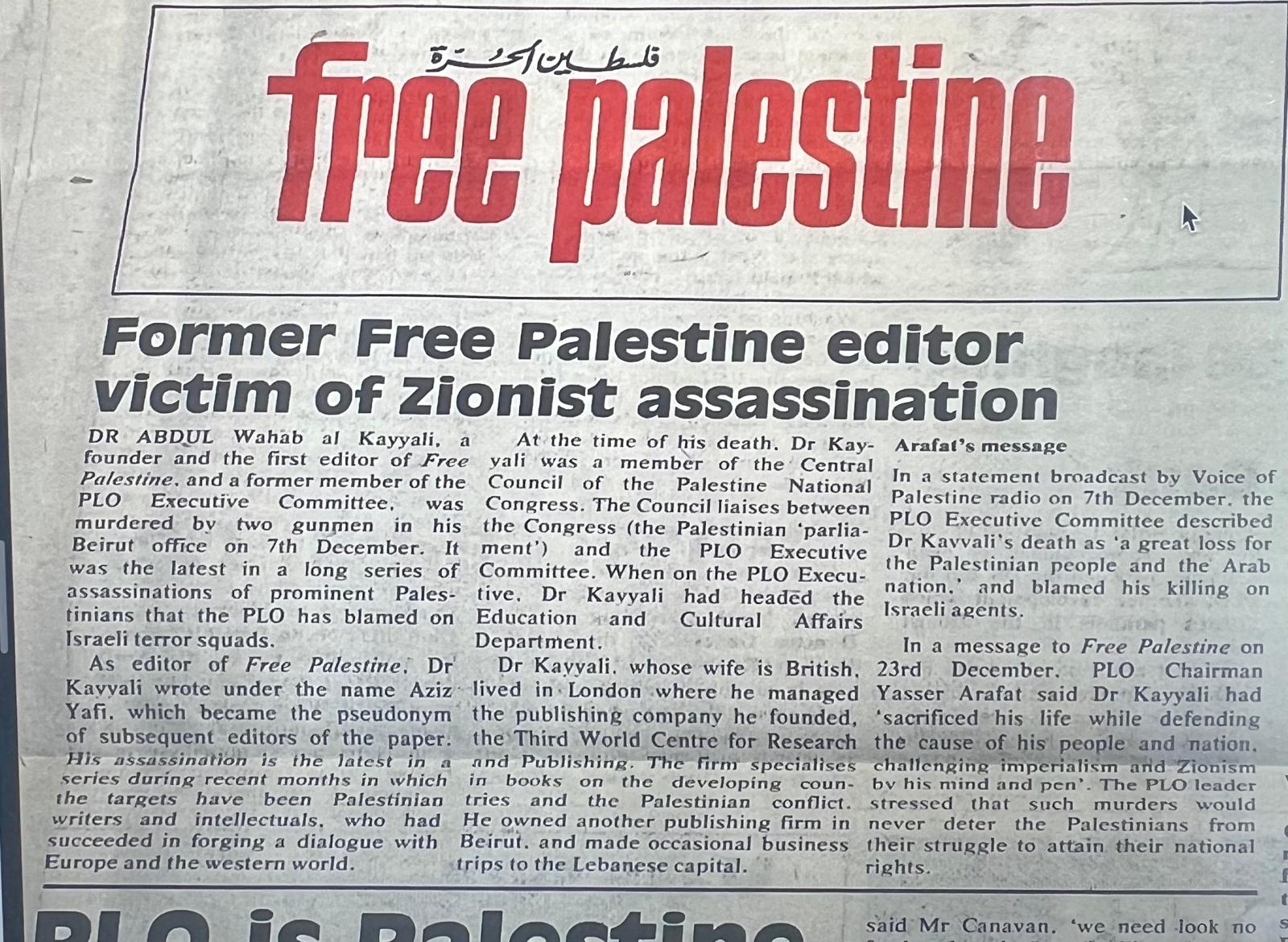
The first editorial was written by Dr. Abdel Wahab Al Kayyali, under the pen name ‘Aziz M. Yafi’. The magazine’s first editor, Kayyali lived primarily in London with his British wife, where he ran his publishing company, the Third World Centre for Research and Publishing, which specialized in books on developing countries and Palestine. He was also involved in a publishing venture in Beirut, which he visited periodically, according to accounts by his colleagues. From 1973, he headed the Education and Cultural Affairs Department of the PLO Executive Committee and became a member of the Palestine National Council. His pen name continued to appear regularly in the magazine, contributing to sections such as ‘Palestine Brief’ and ‘Palestine in the Western Press’. That is, until his assassination during one of his trips to Beirut. Kayyali was killed in his office on 7 December 1981, which the PLO attributed to an Israeli hit squad, and linked to a broader campaign targeting Palestinian intellectuals. Subsequent editors continued to use his penname—Aziz M. Yafi—as a pseudonym and tribute to his legacy.
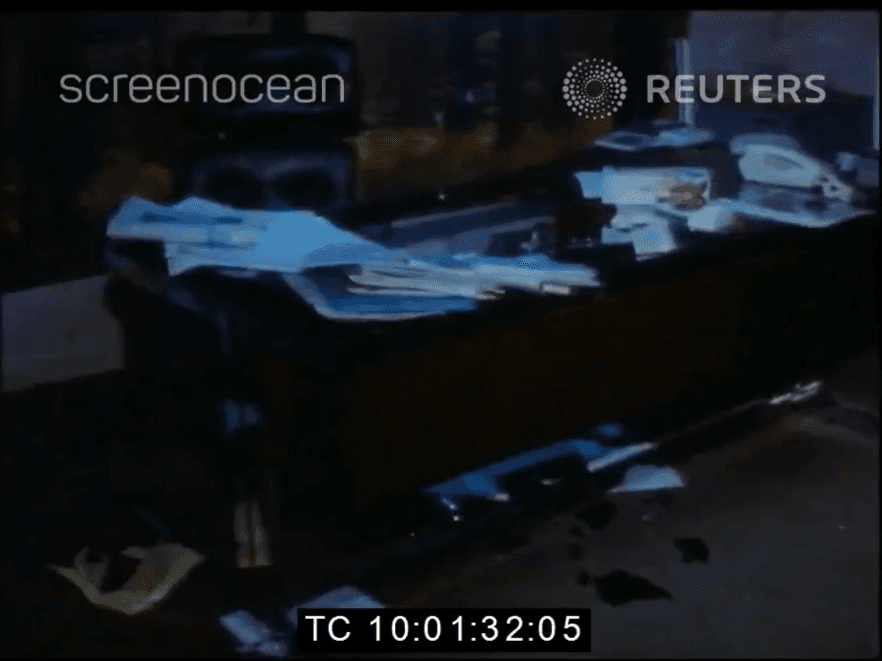
Figure 4. Dr. Abdel Wahab Al Kayyali office at the time of his assassination as reported by Reuters in 1981.

Figure 5. Free Palestine editorial team confirms in their issues in 1982 that Aziz Yafi is the pen name of Dr. Abdul Wahab al Kayyali.
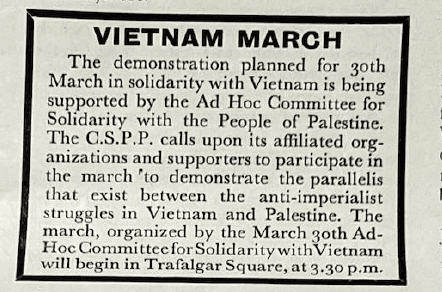
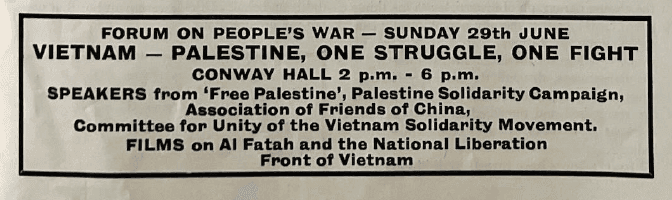
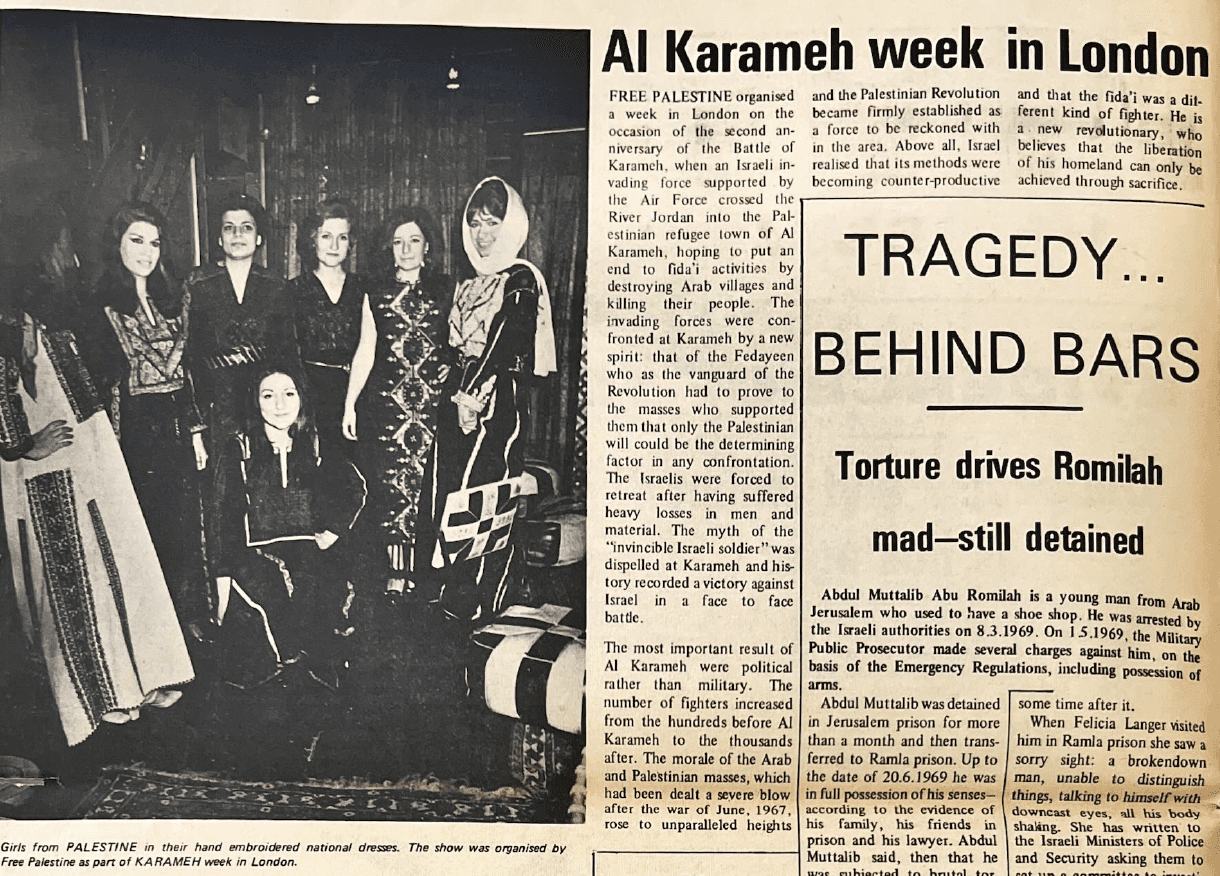
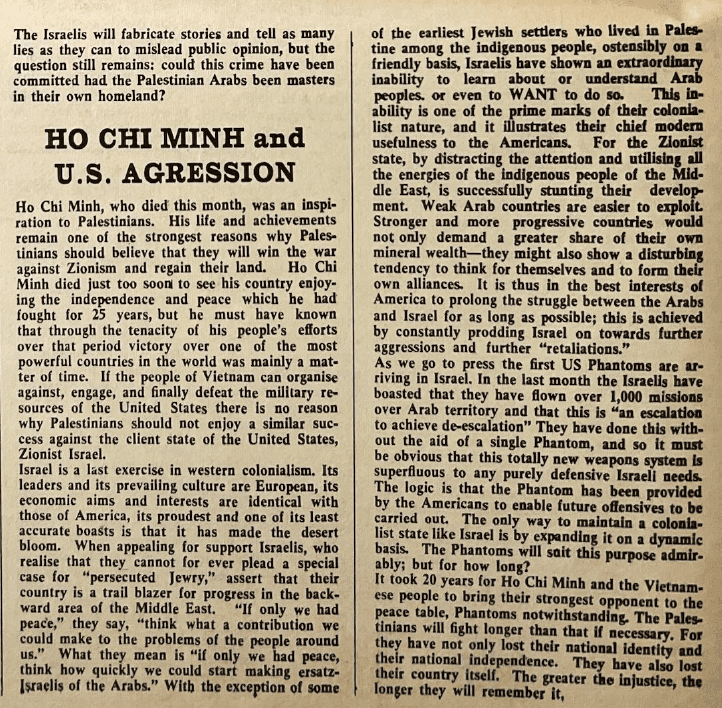
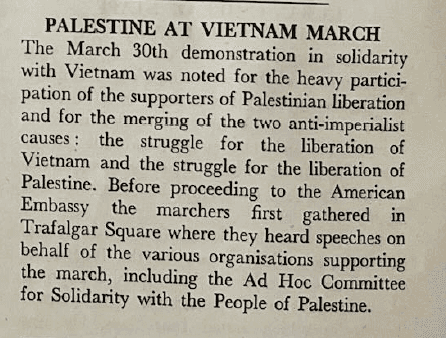
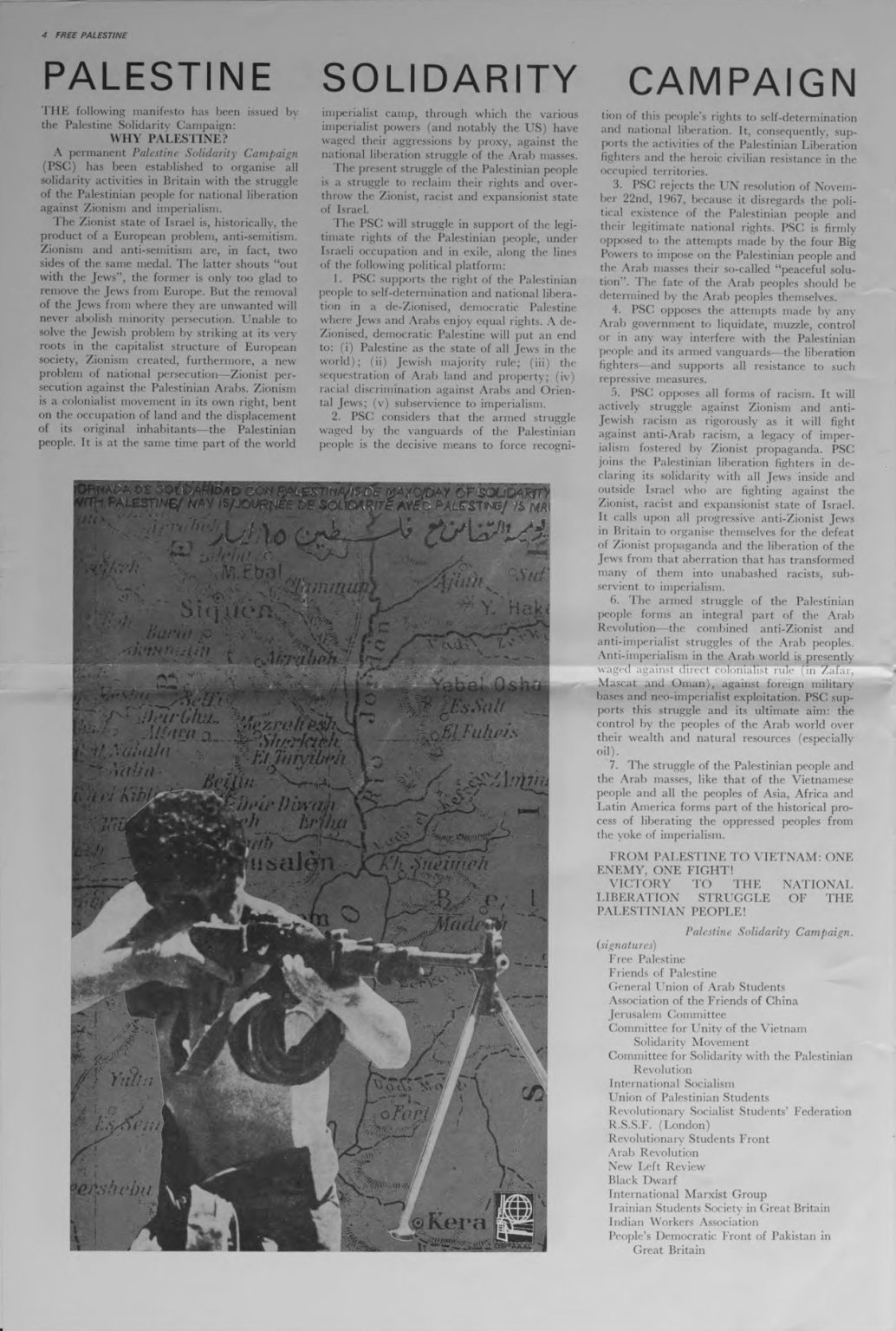
Over the course of its publication, the magazine had several other named editors from various sections of the growing movement of solidarity with Palestine in Britain. This included several youth and student organizers, such as Ghayth Armanazi, editor from 1969-70, a student in London from Syria and a Fatah member, who founded the activist group Friends of Palestine (FOP) in 1968. A leaflet produced by FOP is reproduced in the paper that explains who they are and defines their aims and objectives. The leaflet highlights, ‘the parallels that can be drawn between the struggle against Zionism in Palestine and against the imperialist U.S. aggression in Vietnam,’ and was initially handed out at the 27 October 1968 Vietnam solidarity demonstration in London. This march was also covered in the paper, which described the ‘heavy participation of the supporters of Palestinian liberation.’ As the pages of Free Palestine show us, FOP worked extensively within networks of European and Arab and Palestinian students in order to facilitate exchanges and solidarity between them.
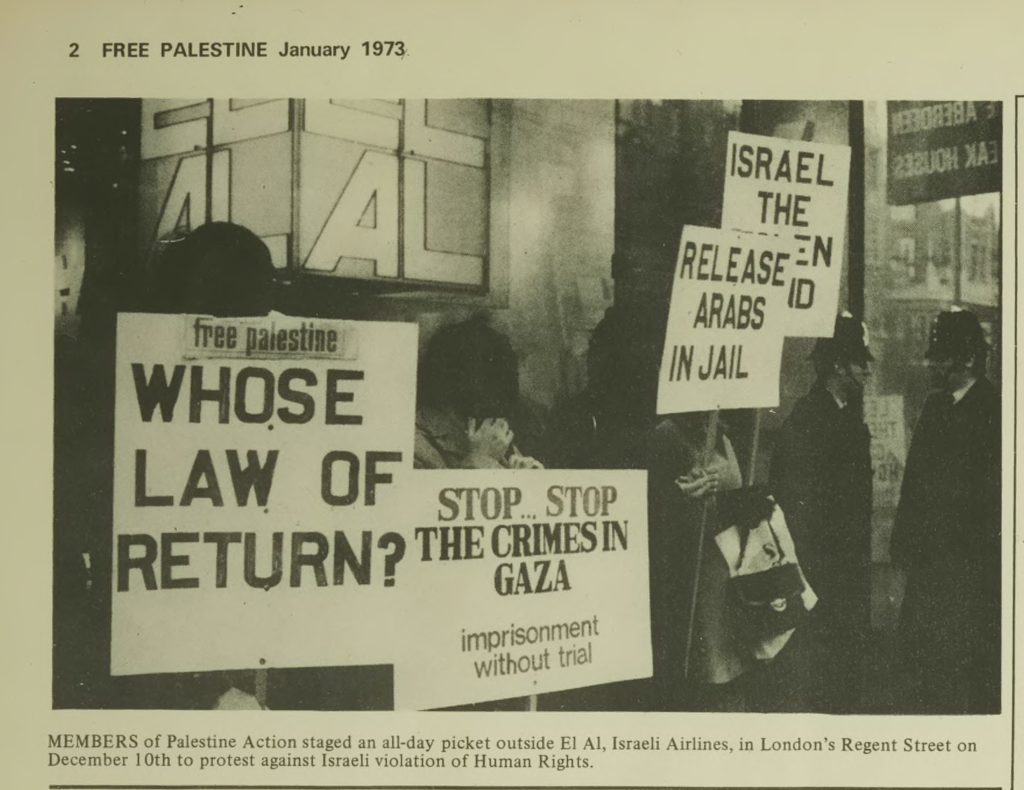
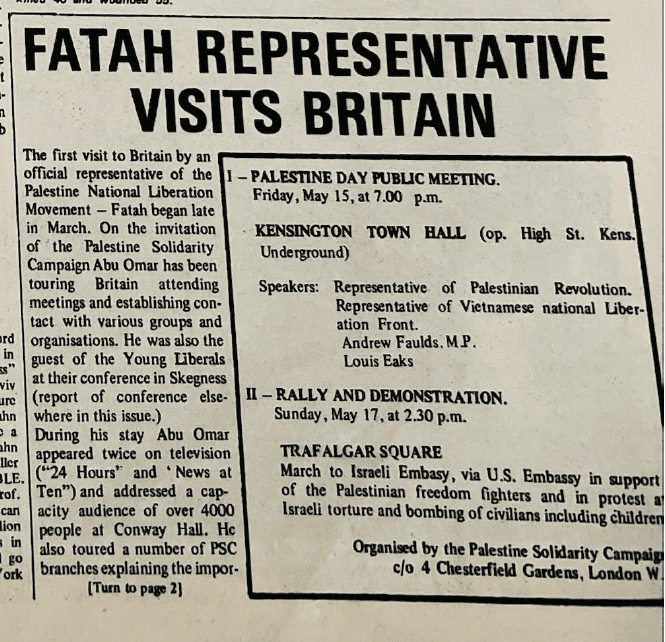
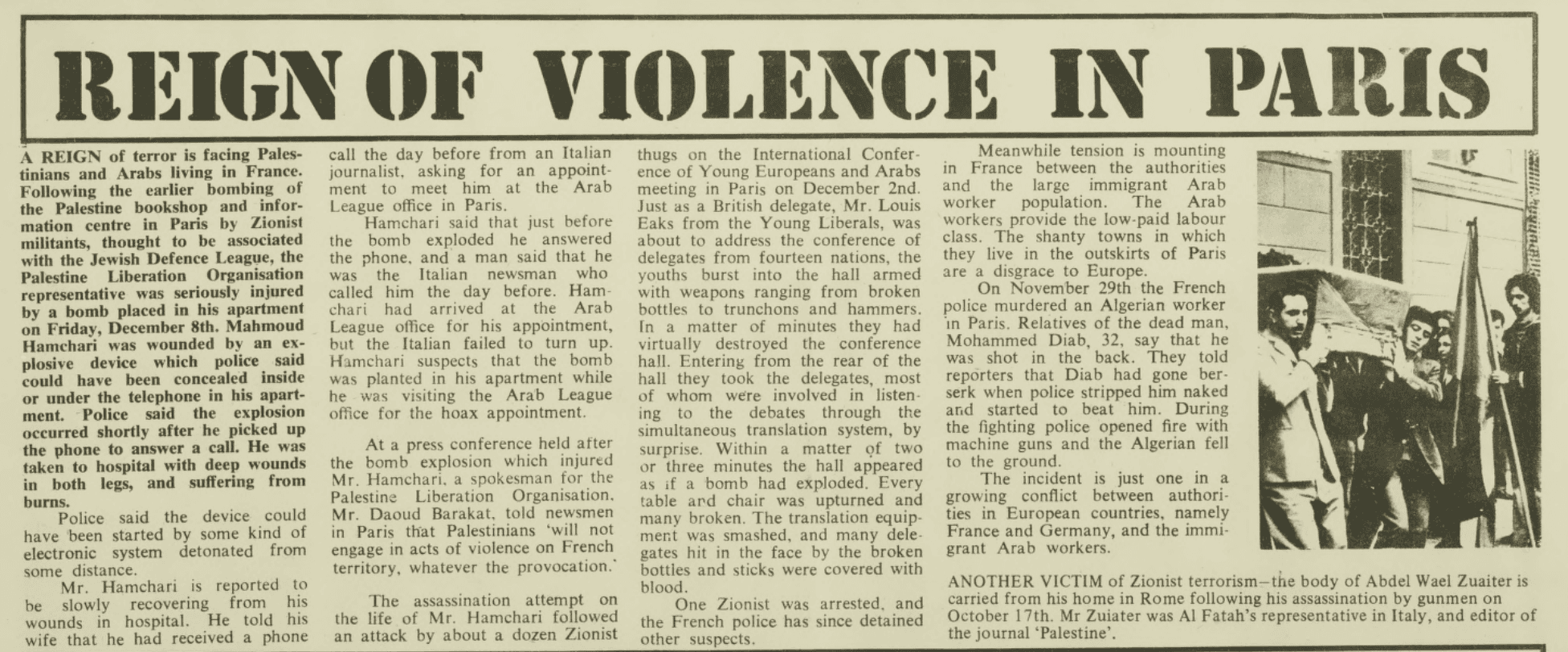
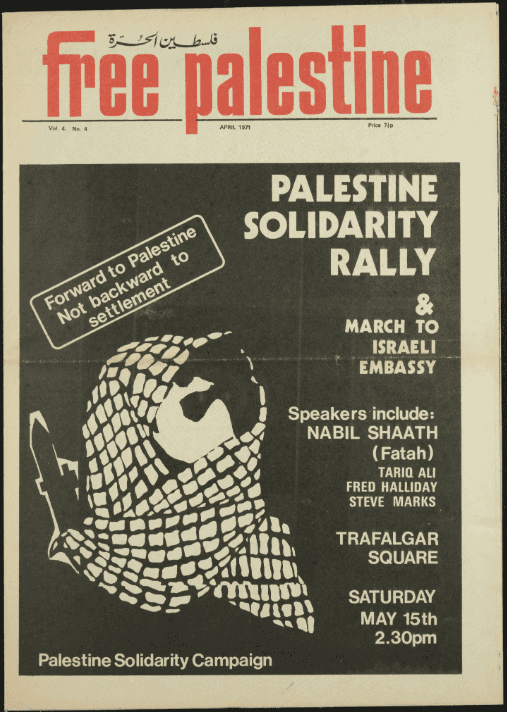
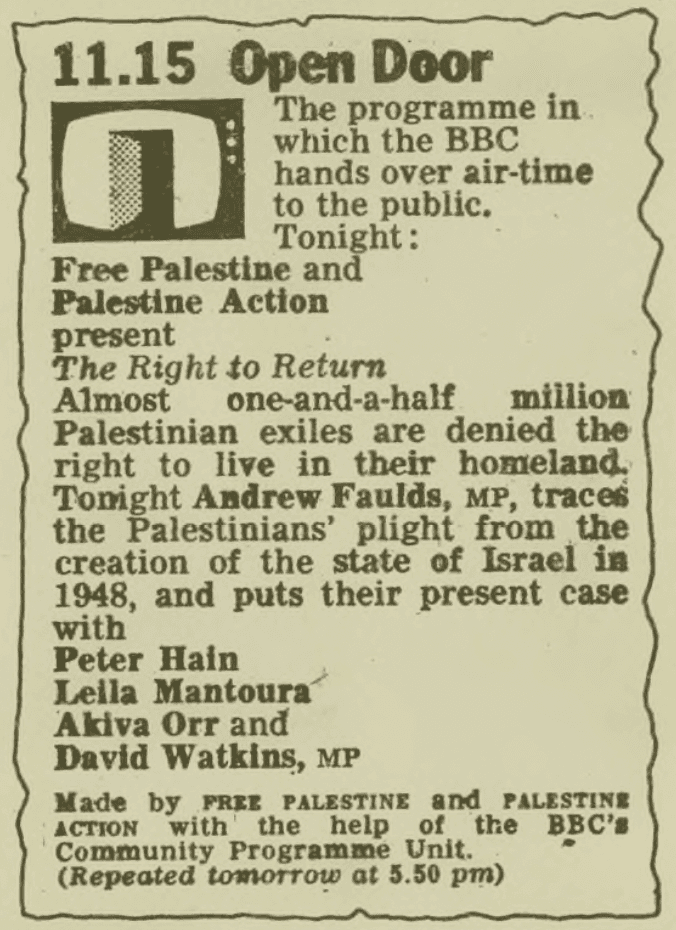
Another editor who came from youth and student networks was Louis Eakes, editor from 1970-74, a leader member and chairman of the Young Liberals and closely affiliated with Palestine Action (a campaign group formed in 1973 by Palestinian doctor Ghada Karmi that lasted until the late 1970s). Eakes was a prominent voice across a range of solidarity campaigns and liberation fronts in the 1970s. He was passionately involved in the South African and Palestinian struggles, having co-organized the ‘Stop the Seventy’ anti-apartheid campaign against the South African cricket team tour of England in 1970. That same year, he was arrested by the police in Highbury Fields, Islington, during an entrapment exercise, an incident which sparked a wave of protests led by the Gay Liberation Front against police hostility and brutality against gay people. After his release, he made a three-month tour of the Arab countries at the invitation of Fatah, where he met with Palestinian revolutionaries, unions, students and intellectuals. These experiences formed part of his political imprint upon the magazine, and guided his activism beyond its pages.
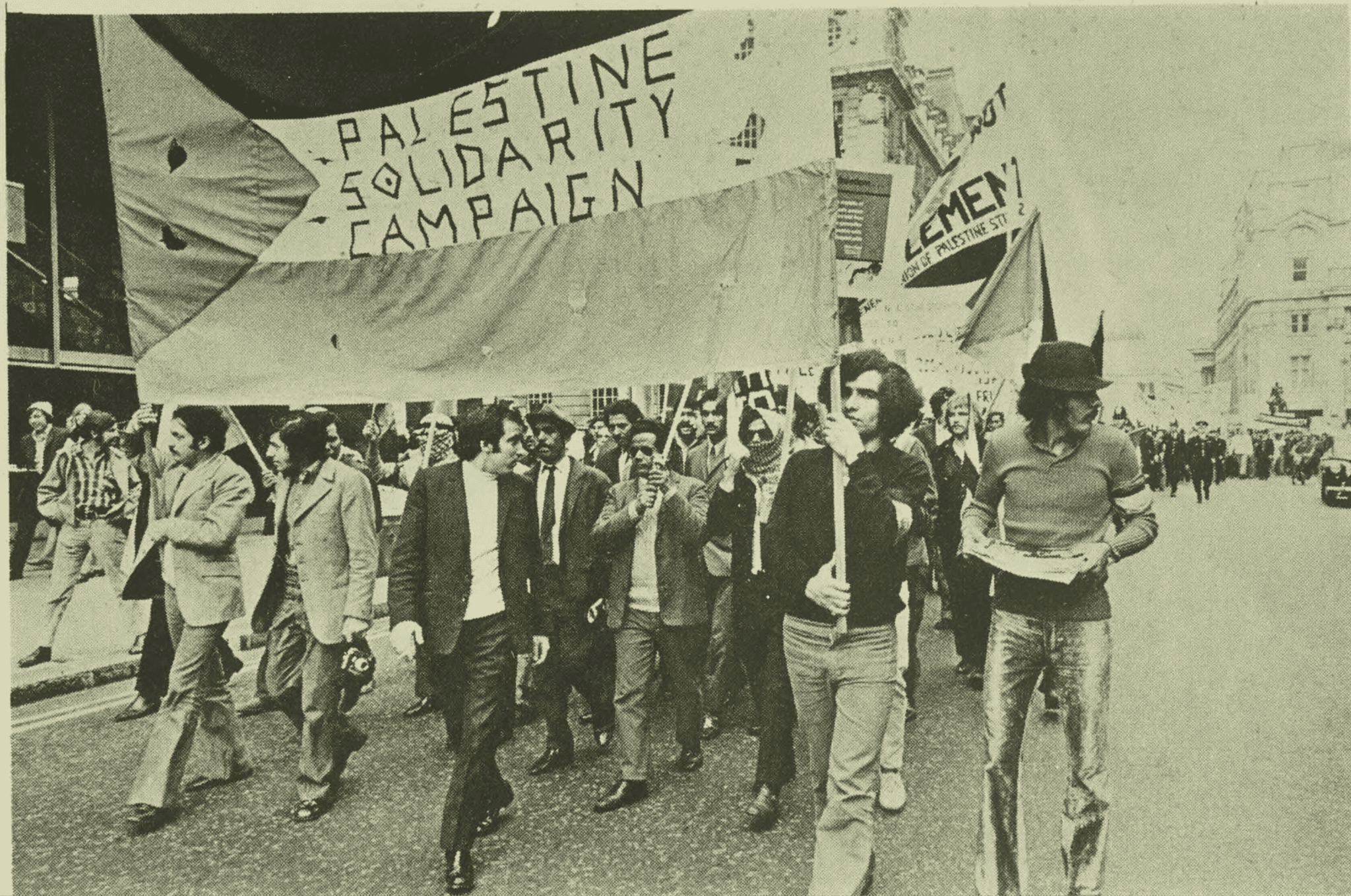
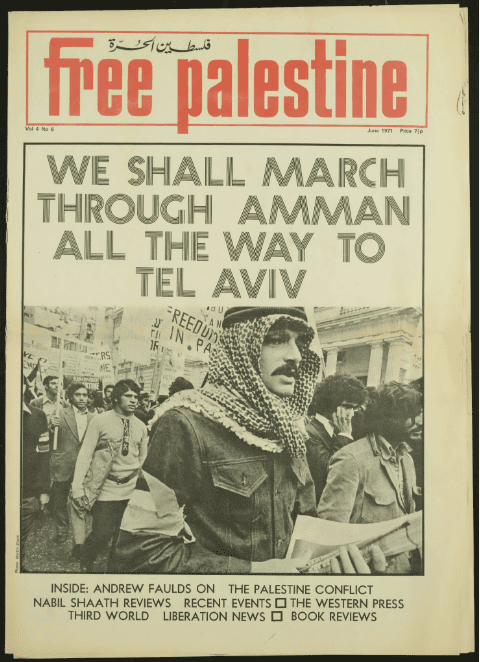
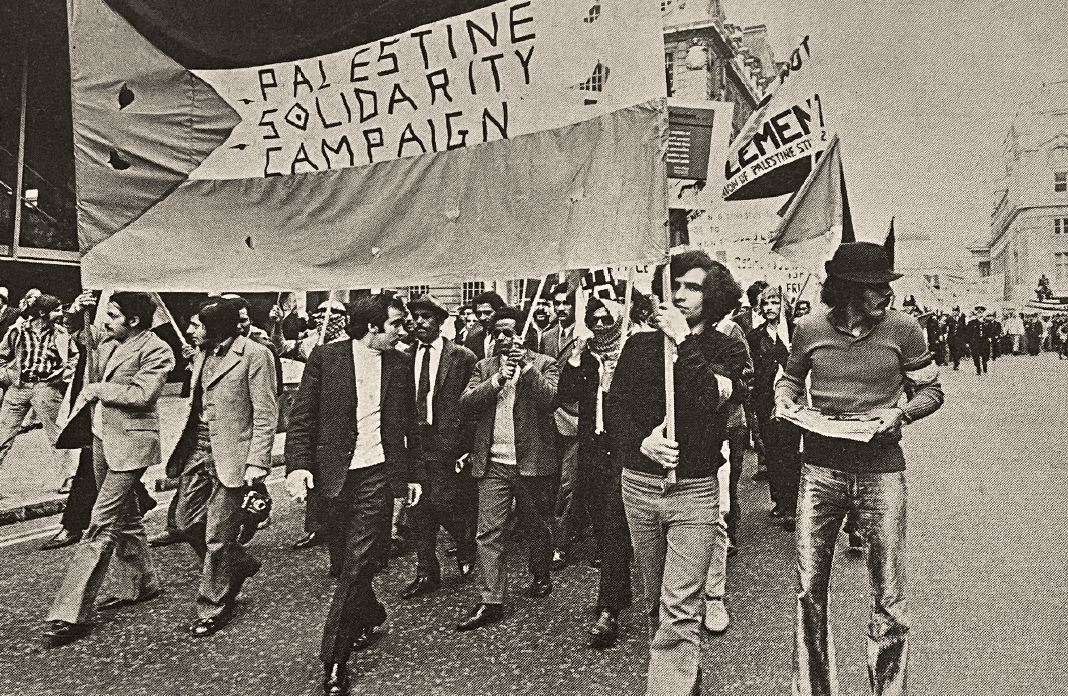
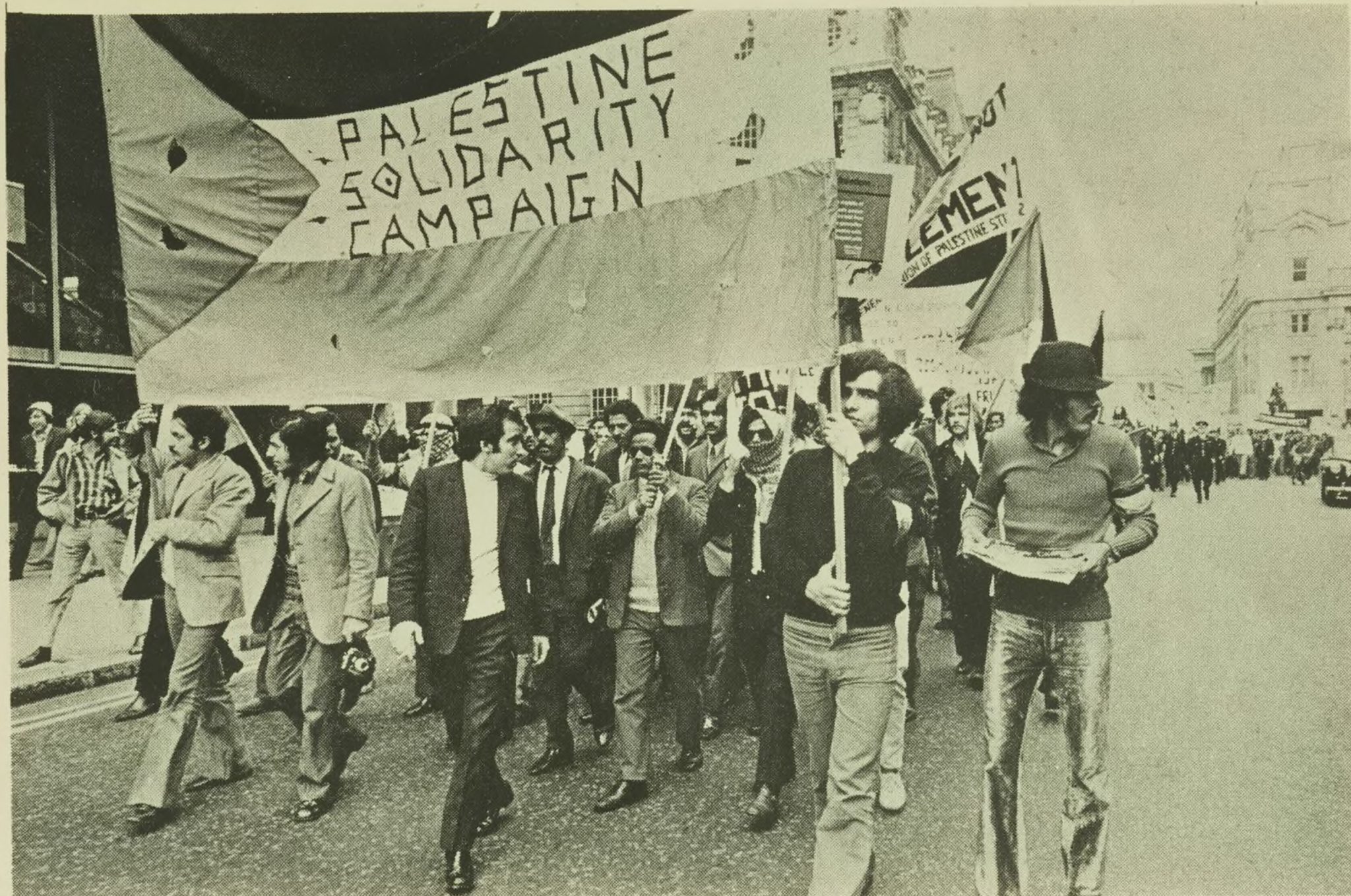
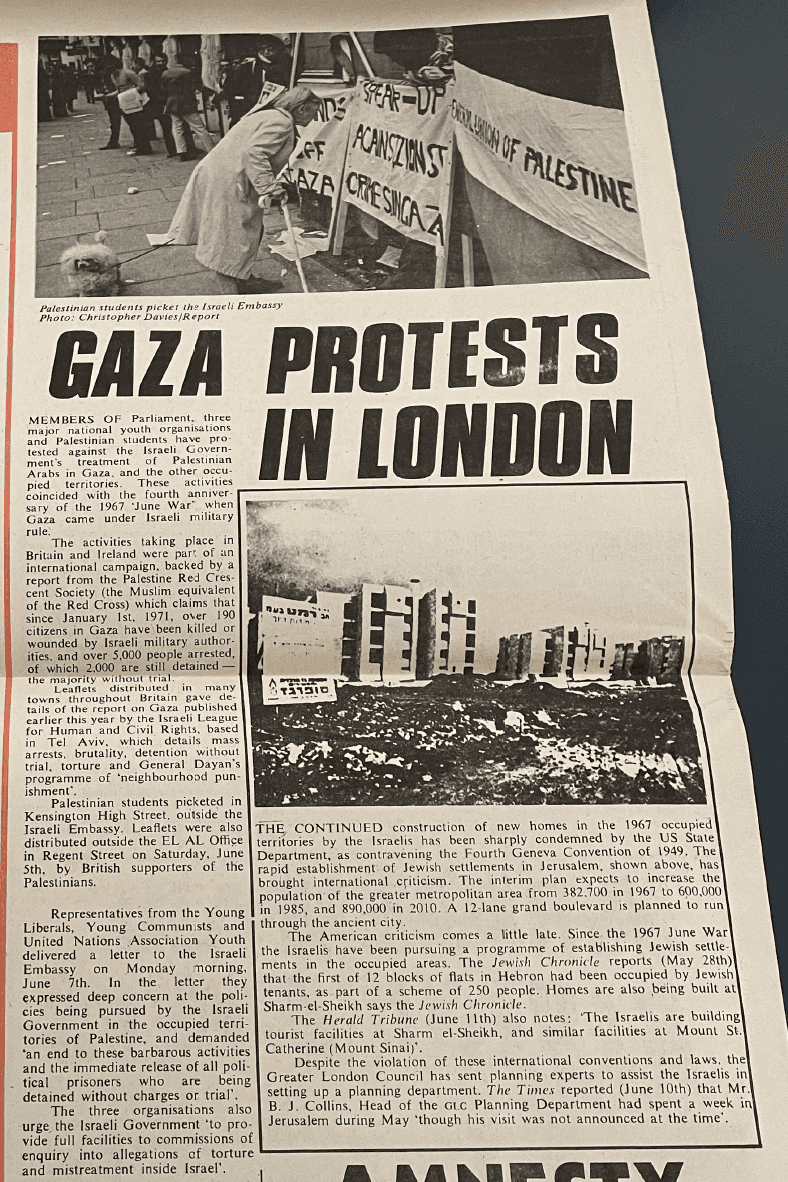
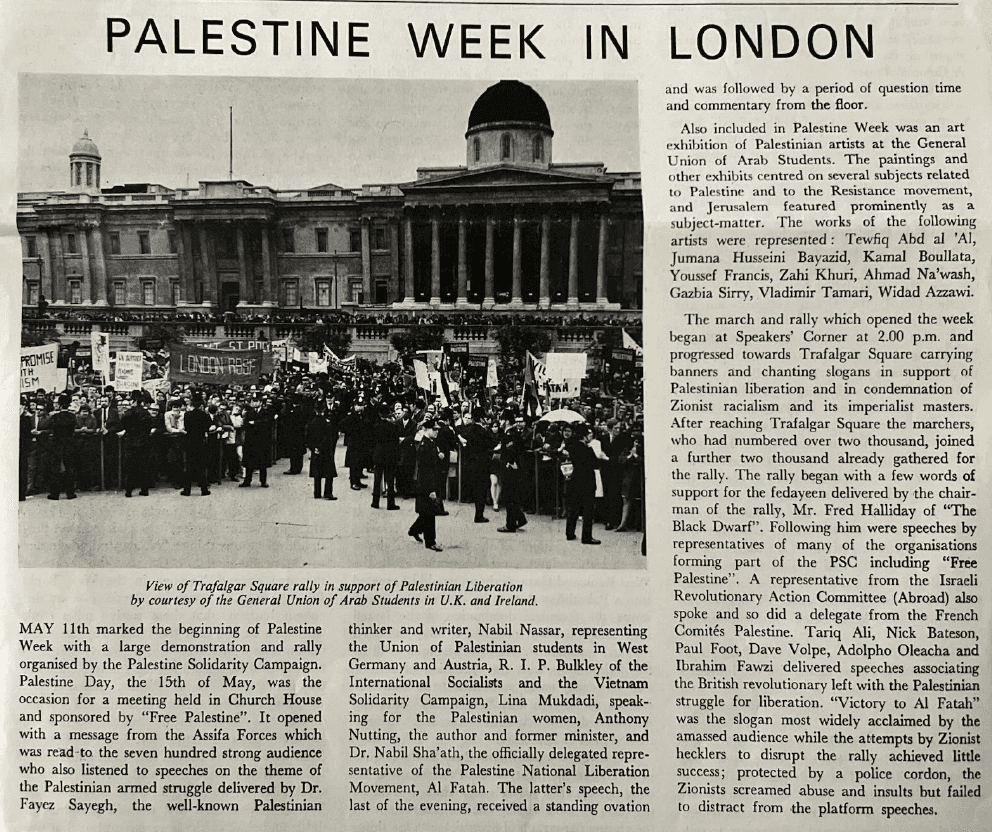
Figure 6. Protestors from the Palestine Solidarity Campaign in London, published by Free Palestine magazine in June 1971.
The publication has played a crucial and practical role in translating connections amongst organizers into actual points of contact and information exchange amongst solidarity movements. Between 1968 and 1978, Free Palestine published an international directory of Palestine solidarity groups, listing aims, objectives, and contact information. From 1978 onwards, the directory focused on the UK while including periodic updates on international organizations. To be advertised, groups had to send their aims, objectives and address. In addition, the paper states that inclusion in the directory did not “imply any association between Free Palestine and the organizations listed.” They explicitly reject any group that “promotes anti-Jewish objectives” and that submissions were “accepted on the understanding that such views are not held by the group.”
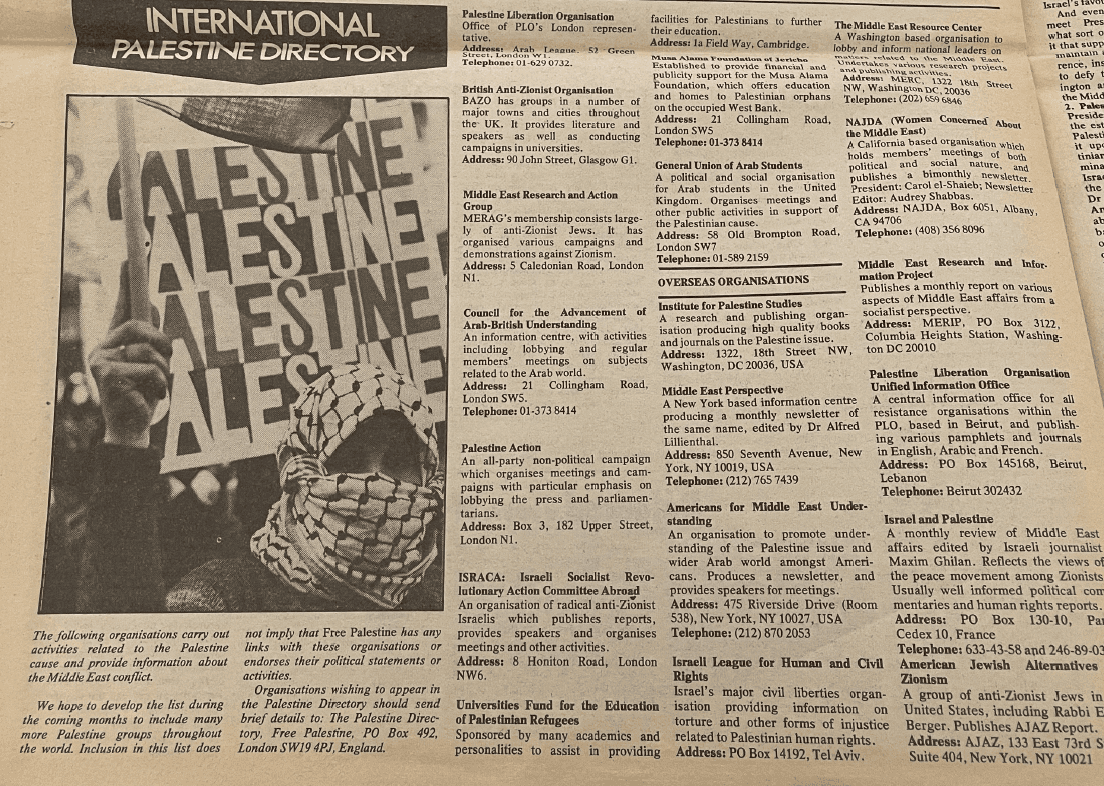
Figure 7. An "international Palestine directory" published by Free Palestine magazine in July, 1978, detailing organizations that “carry out activities related to the Palestine cause and provide information…”
Papers, book reviews, and newsletters of these organizations created routes of contact, a shared calendar of actions and activities, and a common language across organizations that otherwise moved in parallel. They carried news from the Palestinian refugee camps and the occupied territories into union branches and student unions, carried debates from British meetings back into wider solidarity circuits, and functioned as a noticeboard. One example is the materials of the Fifth of June Society, based in Beirut and led by Palestinian novelist Soraya Antonius. The Society welcomed visiting journalists to Beirut and would organize their visits to meet Palestinian revolutionaries and tours of the camps. But they also distributed lists of film and book recommendations to Free Palestine, who would then pass these on to the organizations within their networks. Another example of a more directly physical route of communication was the testimony published by a British student who had attended a three-week summer camp at a base of the Palestinian Revolution on the outskirts of Amman, Jordan. In the testimony, he recounts the political discussions that took place between the camp participants and their Palestinian hosts, including on Marxist and anticolonial revolutionary theory, which the student participants then carried onwards as they returned to campaign for Palestine in their home countries.
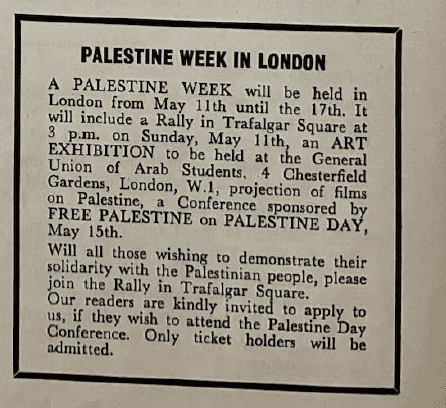
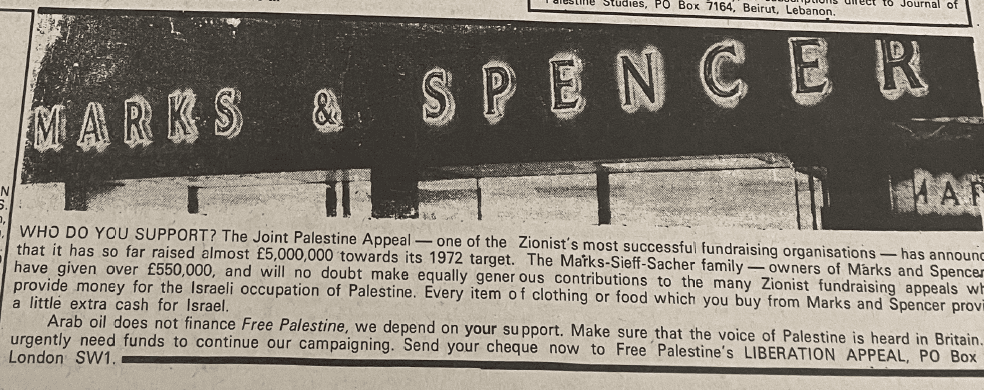
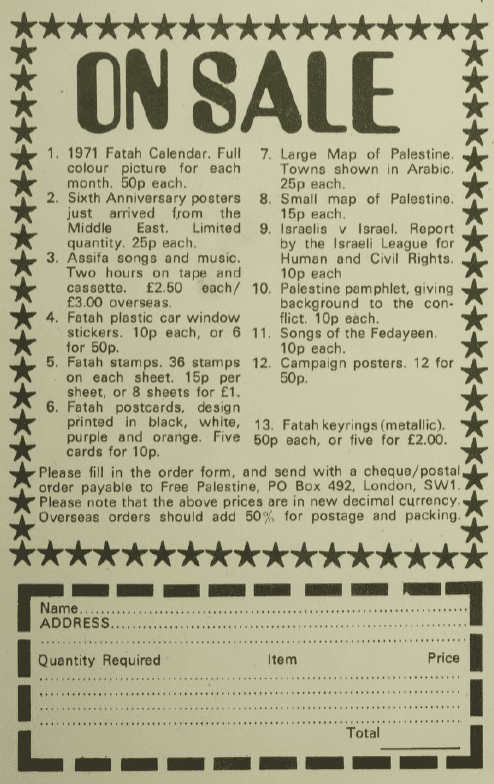
Across its pages and sections, Free Palestine brought together Palestinian students, Arab student unions, left groupings, trade unionists, parliamentarians, church networks, anti-apartheid organizers, and Vietnam solidarity campaigns often affirming their common struggle against imperialism. Its crowded columns listed organizations and contact details, reproduced leaflets and manifestos, announced demonstrations and teach-ins, and reported back on what happened afterward. It published minutes of movement life: conference reports, summer camps, delegations, internal disputes, financial appeals, and the small logistics of keeping an office open and a magazine in circulation.
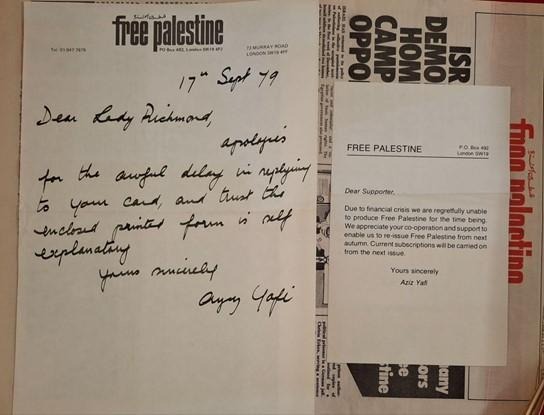
Figure 8. Letter from Free Palestine (September 1979). Richmond Papers, EUL MS 115/35 and MS 115/19/8. Reproduced courtesy of Special Collections, University of Exeter.
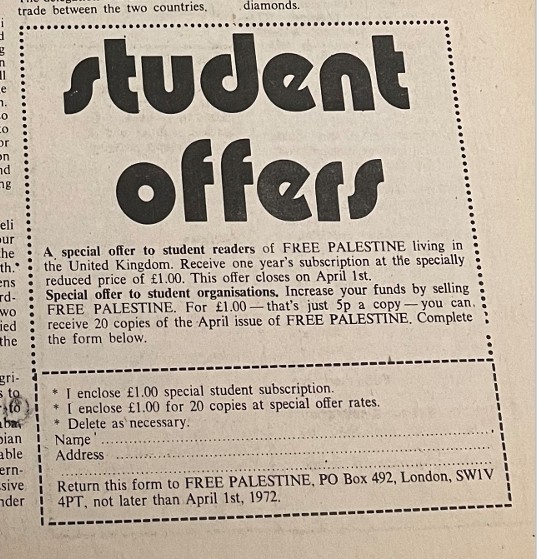
Free Palestine’s coverage of the shifting organizational landscape in this era is a reminder of the remarkable durability and consistency of the publication itself for almost two decades. Despite experiencing financial difficulties in 1979 and temporarily halting publication, the magazine resumed circulation and continued until the mid-1980s. Featured here is a handwritten note from Kayyali, two years before his assassination, addressed to Lady Diana Richmond, a prominent campaigner for Palestinian rights. The note accompanied a printed letter explaining the temporary suspension of Free Palestine due to financial constraints. Yet the magazine survived this crisis and continued operating until the late 1980s.
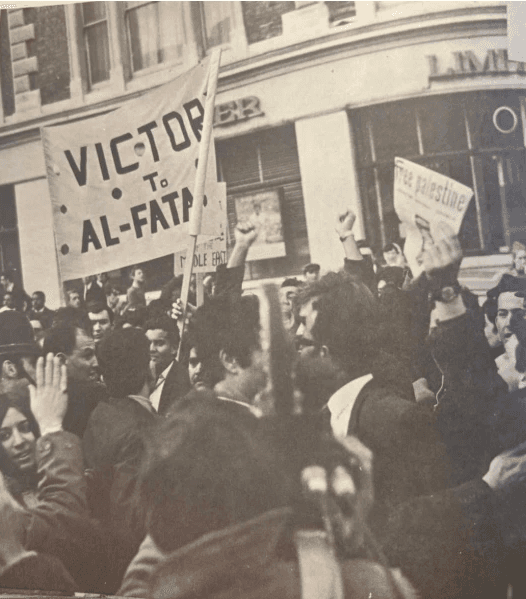
Figure 9. Protestor holding “Free Palestine Magazine” in one of London’s protests (undated). Photo published in a photo album by the Palestine Research Centre in Beirut in 1969.
Reactivating magazines such as Free Palestine opens us up to a lost, forgotten, or at least often deeply buried world of internationalist solidarity, and the connections, bonds, ideologies, practices, and shared histories on which activists drew to globalize anticolonial praxis. Such retrievals are of importance in the case of Palestine, where a lack of institutional archiving is compounded by active attempts to erase the Palestinian people, their history, and their struggle. As part of its broader settler-colonial project, and its genocide and scholasticide in Gaza and beyond, Israel has repeatedly looted and attempted to suppress Palestinian intellectual and cultural production. Today, in Gaza, the same pattern continues, with students and academics murdered, books burned, universities bombed, and entire knowledge systems targeted with destruction and erasure. Reading Free Palestine in this light, we can see that huge strides have been made in ‘mainstreaming’ support for Palestinian liberation amongst large sections of the British population, a significant achievement that, nonetheless, has yet to be translated into a movement capable of ending Britain’s military, economic, and diplomatic support for Israel.
Free Palestine is one example from a global archive that reflects the everyday infrastructure of solidarity rooted in student movements, grassroots campaigns, and broader anti-colonial networks. This archive’s strength lies in its fragmentation, its refusal to either be erased or held in one place. Scattered across time and space—archived in homes, university libraries, community centers, student unions, and across exilic networks—it waits to be revived, reprinted, reshared. To return to Free Palestine today is not simply to remember or preserve it as a historical source, but to allow it to speak again, and to inform and inspire the present. Free Palestine serves as a sounding board for activists, against which to contrast the current stage of struggle. In a moment when solidarity is again being criminalized, misrepresented, or silenced, to articulate the same simple messages against colonial murder can acquire a sense of futility. Yet what Free Palestine reminds us is that resistance is cumulative, and that the archive disrupts linear historical timelines that seek to isolate past struggles from present ones. Its issues reveal the intimate and urgent entanglements between then and now, the unfinished work that begs to be picked up again, and the continuities and similarities in the tactics used by those in power to repress and marginalize. Revisiting such material helps us interrupt the amnesia imposed by censorship, displacement, and repression, and thereby transmit past struggles and hard-won lessons into the present.
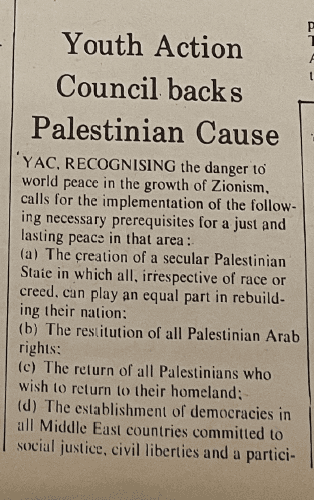
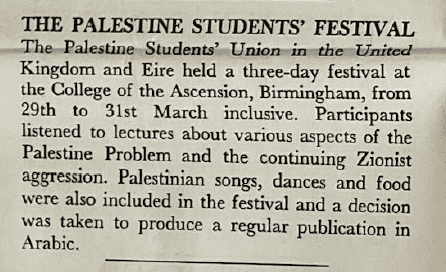
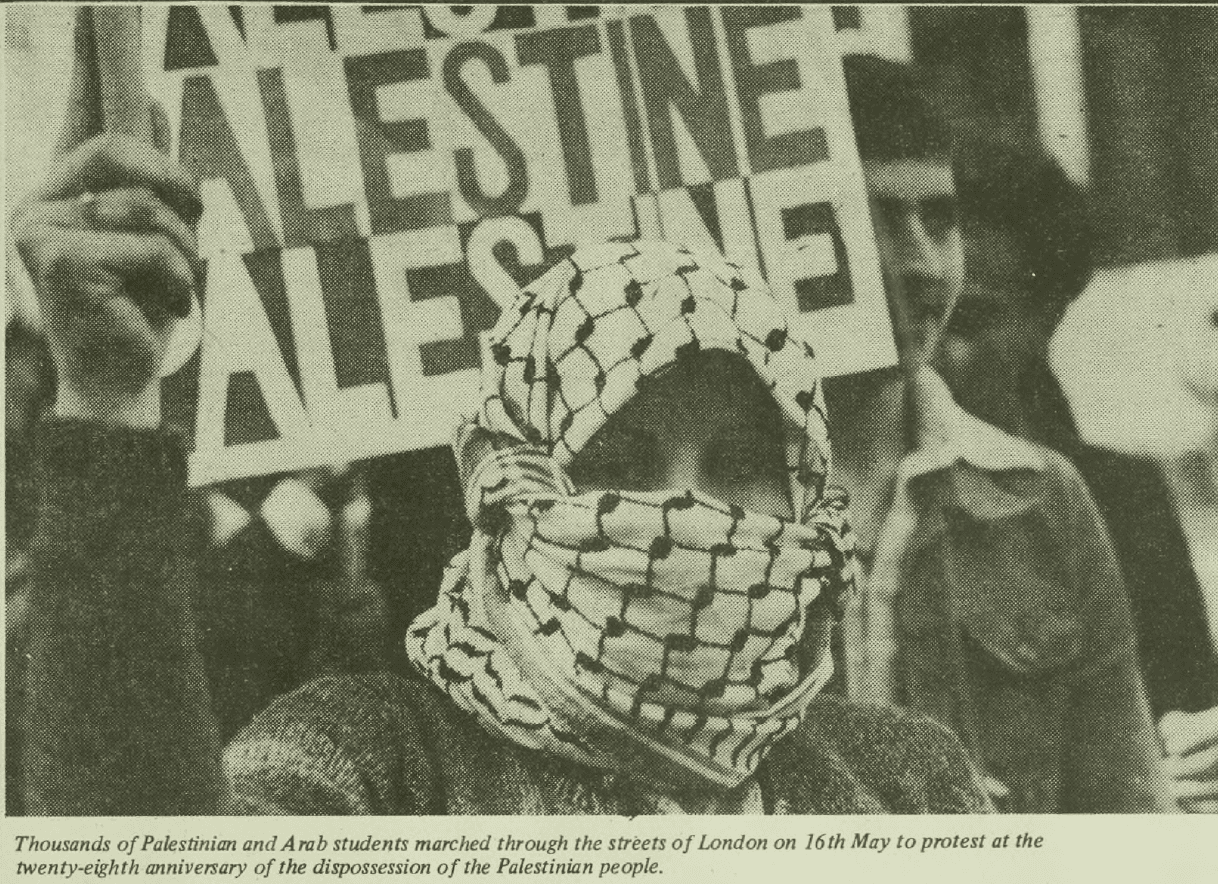
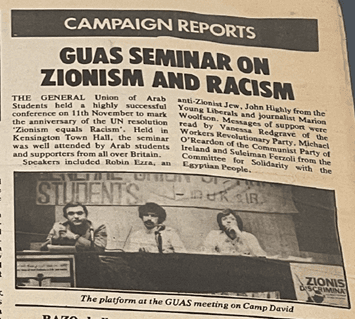
Some sections of Free Palestine can be viewed as straightforward in their aims, to humanize Palestinians by explaining who they are, what has happened to them, their rights, and their hopes for the future. Other parts repeat known facts of Western complicity, a chronicle of Israeli, British, and US crimes, that the magazine was seeking to relay to its readers, teaching a Western audience its own history. In all these cases, repetition is a method of asserting truth and confronting erasure, a means of mass education to expose complicity, intervene in national and global politics, and mobilize masses to speak up, act, organize, and boycott. This visual portal into the magazine lets you navigate key themes in archival activation. As with a more literal, tactile experience of encountering such a magazine in an archive, moving through these themes is not a linear experience. They interact and overlap, and each encounter might activate new lines of connection.
All images from the magazine are reproduced courtesy of Special Collections, University of Exeter.
In June 1968, Dr. Abdulwahab Kayyali, a PhD student at University College London, founded the Free Palestine magazine alongside other Palestinians and allies residing in Britain. From a small office in central London, the group produced the publication in its entirety, from writing and editing to printing and distribution. Published monthly in Britain until the late 1980s, Free Palestine now constitutes a largely overlooked archive of the Palestine solidarity movement during a formative period of global political realignment and struggle. Despite precarious funding conditions, and having to operate within a hostile Zionist climate, the magazine circulated widely, from its offices in London to reach student groups, solidarity committees, parliamentary offices, embassies, conferences, refugee camps, and prisons across the world.
It was published mainly during the years of the Palestinian Revolution, when the horizon of liberation was expanding in sight and resonance across the world. This period followed the Arab defeat in the June 1967 War, after which Palestinian resistance organizations assumed control of the Palestine Liberation Organization (PLO) and reoriented it as a national umbrella committed to liberation through armed struggle. These organizations were inspired by and built networks with fraternal anticolonial and socialist struggles in Algeria, Vietnam, Cuba, China, and elsewhere. Alongside Palestinian unions of women, students, workers, artists, and more, they engaged in a widespread solidarity-building campaign to center Palestinian liberation by communicating its aims, strategies, histories, and visions to the rest of the world.
Figure 1. screenshot form the magazine detailing the team and office.
Figure 2. Free Palestine being printed and distributed from an office in Pimlico, London. Still from footage found on British Pathe (undated and now removed).
Free Palestine functioned simultaneously as a means of communication and as a record of solidarity in practice. Its pages included reports on the conditions in Palestine and in exile, accounts of Israeli colonial violence, the activities of the Palestinian liberation movement, exclusive interviews with Palestinian leaders and political figures, and letters and correspondence from readers. It offered analysis of Western media representations of Palestinians and Palestine, published educational materials, documented conferences, delegations, and summer camps, and covered connections with other internationalist struggles for liberation. In addition to spreading information and mobilizing support through the paper, the team behind the publication participated in speaking tours, demonstrations, and lobbying alongside other organizations and individuals committed to the principles of Palestinian liberation.
The day-to-day workings of Free Palestine can be glimpsed through their scattered archival records, which consist primarily of correspondence between editors and with their readers, associated organizations, and supporters. This correspondence details the back and forth between people that constituted the making of the magazine. Readers and supporters were regularly invited to send letters to a P.O. Box in southwest London, suggesting a sustained dialogue between the publication and its audience. Different editors took the lead at various points in the magazine’s lifetime, each bringing to some extent their own editorial style and political networks to the pages of the publication.
Figure 3. First Issue of Free Palestine issues in June, 1968 with an editorial written by Aziz M. Yaffi detailing the magazine’s aims.
The first editorial was written by Dr. Abdel Wahab Al Kayyali, under the pen name ‘Aziz M. Yafi’. The magazine’s first editor, Kayyali lived primarily in London with his British wife, where he ran his publishing company, the Third World Centre for Research and Publishing, which specialized in books on developing countries and Palestine. He was also involved in a publishing venture in Beirut, which he visited periodically, according to accounts by his colleagues. From 1973, he headed the Education and Cultural Affairs Department of the PLO Executive Committee and became a member of the Palestine National Council. His pen name continued to appear regularly in the magazine, contributing to sections such as ‘Palestine Brief’ and ‘Palestine in the Western Press’. That is, until his assassination during one of his trips to Beirut. Kayyali was killed in his office on 7 December 1981, which the PLO attributed to an Israeli hit squad, and linked to a broader campaign targeting Palestinian intellectuals. Subsequent editors continued to use his penname—Aziz M. Yafi—as a pseudonym and tribute to his legacy.
Figure 4. Dr. Abdel Wahab Al Kayyali office at the time of his assassination as reported by Reuters in 1981.
Figure 5. Free Palestine editorial team confirms in their issues in 1982 that Aziz Yafi is the pen name of Dr. Abdul Wahab al Kayyali.
Over the course of its publication, the magazine had several other named editors from various sections of the growing movement of solidarity with Palestine in Britain. This included several youth and student organizers, such as Ghayth Armanazi, editor from 1969-70, a student in London from Syria and a Fatah member, who founded the activist group Friends of Palestine (FOP) in 1968. A leaflet produced by FOP is reproduced in the paper that explains who they are and defines their aims and objectives. The leaflet highlights, ‘the parallels that can be drawn between the struggle against Zionism in Palestine and against the imperialist U.S. aggression in Vietnam,’ and was initially handed out at the 27 October 1968 Vietnam solidarity demonstration in London. This march was also covered in the paper, which described the ‘heavy participation of the supporters of Palestinian liberation.’ As the pages of Free Palestine show us, FOP worked extensively within networks of European and Arab and Palestinian students in order to facilitate exchanges and solidarity between them.
Another editor who came from youth and student networks was Louis Eakes, editor from 1970-74, a leader member and chairman of the Young Liberals and closely affiliated with Palestine Action (a campaign group formed in 1973 by Palestinian doctor Ghada Karmi that lasted until the late 1970s). Eakes was a prominent voice across a range of solidarity campaigns and liberation fronts in the 1970s. He was passionately involved in the South African and Palestinian struggles, having co-organized the ‘Stop the Seventy’ anti-apartheid campaign against the South African cricket team tour of England in 1970. That same year, he was arrested by the police in Highbury Fields, Islington, during an entrapment exercise, an incident which sparked a wave of protests led by the Gay Liberation Front against police hostility and brutality against gay people. After his release, he made a three-month tour of the Arab countries at the invitation of Fatah, where he met with Palestinian revolutionaries, unions, students and intellectuals. These experiences formed part of his political imprint upon the magazine, and guided his activism beyond its pages.
Figure 6. Protestors from the Palestine Solidarity Campaign in London, published by Free Palestine magazine in June 1971.
The publication has played a crucial and practical role in translating connections amongst organizers into actual points of contact and information exchange amongst solidarity movements. Between 1968 and 1978, Free Palestine published an international directory of Palestine solidarity groups, listing aims, objectives, and contact information. From 1978 onwards, the directory focused on the UK while including periodic updates on international organizations. To be advertised, groups had to send their aims, objectives and address. In addition, the paper states that inclusion in the directory did not “imply any association between Free Palestine and the organizations listed.” They explicitly reject any group that “promotes anti-Jewish objectives” and that submissions were “accepted on the understanding that such views are not held by the group.”
Figure 7. An "international Palestine directory" published by Free Palestine magazine in July, 1978, detailing organizations that “carry out activities related to the Palestine cause and provide information…”
Papers, book reviews, and newsletters of these organizations created routes of contact, a shared calendar of actions and activities, and a common language across organizations that otherwise moved in parallel. They carried news from the Palestinian refugee camps and the occupied territories into union branches and student unions, carried debates from British meetings back into wider solidarity circuits, and functioned as a noticeboard. One example is the materials of the Fifth of June Society, based in Beirut and led by Palestinian novelist Soraya Antonius. The Society welcomed visiting journalists to Beirut and would organize their visits to meet Palestinian revolutionaries and tours of the camps. But they also distributed lists of film and book recommendations to Free Palestine, who would then pass these on to the organizations within their networks. Another example of a more directly physical route of communication was the testimony published by a British student who had attended a three-week summer camp at a base of the Palestinian Revolution on the outskirts of Amman, Jordan. In the testimony, he recounts the political discussions that took place between the camp participants and their Palestinian hosts, including on Marxist and anticolonial revolutionary theory, which the student participants then carried onwards as they returned to campaign for Palestine in their home countries.
Across its pages and sections, Free Palestine brought together Palestinian students, Arab student unions, left groupings, trade unionists, parliamentarians, church networks, anti-apartheid organizers, and Vietnam solidarity campaigns often affirming their common struggle against imperialism. Its crowded columns listed organizations and contact details, reproduced leaflets and manifestos, announced demonstrations and teach-ins, and reported back on what happened afterward. It published minutes of movement life: conference reports, summer camps, delegations, internal disputes, financial appeals, and the small logistics of keeping an office open and a magazine in circulation.
Figure 8. Letter from Free Palestine (September 1979). Richmond Papers, EUL MS 115/35 and MS 115/19/8. Reproduced courtesy of Special Collections, University of Exeter.
Free Palestine’s coverage of the shifting organizational landscape in this era is a reminder of the remarkable durability and consistency of the publication itself for almost two decades. Despite experiencing financial difficulties in 1979 and temporarily halting publication, the magazine resumed circulation and continued until the mid-1980s. Featured here is a handwritten note from Kayyali, two years before his assassination, addressed to Lady Diana Richmond, a prominent campaigner for Palestinian rights. The note accompanied a printed letter explaining the temporary suspension of Free Palestine due to financial constraints. Yet the magazine survived this crisis and continued operating until the late 1980s.
Figure 9. Protestor holding “Free Palestine Magazine” in one of London’s protests (undated). Photo published in a photo album by the Palestine Research Centre in Beirut in 1969.
Reactivating magazines such as Free Palestine opens us up to a lost, forgotten, or at least often deeply buried world of internationalist solidarity, and the connections, bonds, ideologies, practices, and shared histories on which activists drew to globalize anticolonial praxis. Such retrievals are of importance in the case of Palestine, where a lack of institutional archiving is compounded by active attempts to erase the Palestinian people, their history, and their struggle. As part of its broader settler-colonial project, and its genocide and scholasticide in Gaza and beyond, Israel has repeatedly looted and attempted to suppress Palestinian intellectual and cultural production. Today, in Gaza, the same pattern continues, with students and academics murdered, books burned, universities bombed, and entire knowledge systems targeted with destruction and erasure. Reading Free Palestine in this light, we can see that huge strides have been made in ‘mainstreaming’ support for Palestinian liberation amongst large sections of the British population, a significant achievement that, nonetheless, has yet to be translated into a movement capable of ending Britain’s military, economic, and diplomatic support for Israel.
Free Palestine is one example from a global archive that reflects the everyday infrastructure of solidarity rooted in student movements, grassroots campaigns, and broader anti-colonial networks. This archive’s strength lies in its fragmentation, its refusal to either be erased or held in one place. Scattered across time and space—archived in homes, university libraries, community centers, student unions, and across exilic networks—it waits to be revived, reprinted, reshared. To return to Free Palestine today is not simply to remember or preserve it as a historical source, but to allow it to speak again, and to inform and inspire the present. Free Palestine serves as a sounding board for activists, against which to contrast the current stage of struggle. In a moment when solidarity is again being criminalized, misrepresented, or silenced, to articulate the same simple messages against colonial murder can acquire a sense of futility. Yet what Free Palestine reminds us is that resistance is cumulative, and that the archive disrupts linear historical timelines that seek to isolate past struggles from present ones. Its issues reveal the intimate and urgent entanglements between then and now, the unfinished work that begs to be picked up again, and the continuities and similarities in the tactics used by those in power to repress and marginalize. Revisiting such material helps us interrupt the amnesia imposed by censorship, displacement, and repression, and thereby transmit past struggles and hard-won lessons into the present.
Some sections of Free Palestine can be viewed as straightforward in their aims, to humanize Palestinians by explaining who they are, what has happened to them, their rights, and their hopes for the future. Other parts repeat known facts of Western complicity, a chronicle of Israeli, British, and US crimes, that the magazine was seeking to relay to its readers, teaching a Western audience its own history. In all these cases, repetition is a method of asserting truth and confronting erasure, a means of mass education to expose complicity, intervene in national and global politics, and mobilize masses to speak up, act, organize, and boycott. This visual portal into the magazine lets you navigate key themes in archival activation. As with a more literal, tactile experience of encountering such a magazine in an archive, moving through these themes is not a linear experience. They interact and overlap, and each encounter might activate new lines of connection.
All images from the magazine are reproduced courtesy of Special Collections, University of Exeter.


Rami Rmeileh is a Palestinian critical psychologist and pedagogist working with Makan Rights. His work engages with the history of British-based solidarities with Palestine, develops teaching tools and anti-colonial political education curricula, and draws on critical and liberation psychology to understand Palestinian refugee experiences of sumūd (steadfastness) in Lebanon, with attention to class and gender. He holds a BA in Clinical Psychology (Psychoanalysis) from the Lebanese University and an MSc in Cross-cultural Psychology from the University of Oslo and ISCTE – University Institute of Lisbon, and recently completed his PhD at the University of Exeter.
Sorcha Thomson is a historian of tricontinentalism and global solidarities with Palestine. She is Research Fellow in the Socialist Anthropocene in the Visual Arts (SAVA) project and teaches history and politics at UCL and SOAS, University of London. She has been a visiting researcher at the Instituto de Historia de Cuba in Havana and is co-editor of She Who Struggles: Revolutionary Women who Shaped the World (2023) and Palestine in the World: International Solidarity with the Palestinian Liberation Movement (2023).
Rami Rmeileh is a Palestinian critical psychologist and pedagogist working with Makan Rights. His work engages with the history of British-based solidarities with Palestine, develops teaching tools and anti-colonial political education curricula, and draws on critical and liberation psychology to understand Palestinian refugee experiences of sumūd (steadfastness) in Lebanon, with attention to class and gender. He holds a BA in Clinical Psychology (Psychoanalysis) from the Lebanese University and an MSc in Cross-cultural Psychology from the University of Oslo and ISCTE – University Institute of Lisbon, and recently completed his PhD at the University of Exeter.
Sorcha Thomson is a historian of tricontinentalism and global solidarities with Palestine. She is Research Fellow in the Socialist Anthropocene in the Visual Arts (SAVA) project and teaches history and politics at UCL and SOAS, University of London. She has been a visiting researcher at the Instituto de Historia de Cuba in Havana and is co-editor of She Who Struggles: Revolutionary Women who Shaped the World (2023) and Palestine in the World: International Solidarity with the Palestinian Liberation Movement (2023).

PALESTINE IS EVERYWHERE